Friday, September 19, 2014

Probabilistic pragmatics bibliography

Pragmatics is the study of human communication in context. A tremendous amount of experimental and theoretical work has been done on pragmatics since Grice's seminal statement of the cooperative principle. In recent years, a number of people have been working on a new set of formal models of pragmatics, using probabilistic methods and approaches from game theory to quantify human pragmatic reasoning. 

This post is an incomplete bibliography of some of the recent work following this approach. My goal in compiling this bibliography is primarily personal: I want to keep track of this growing literature and the different branches it's taken. I've primarily included research that is either formal/computational in nature, or based directly on formal models. Please let me know in the comments or by email if you have work that you would like added here.
Probabilistic Models and Experimental Tests
One flaw in this literature is that right now there's no one good paper to look at for an intro. The first paper on this list is (IMO) a good introduction, but it's only a page long, so if you want details you have to look elsewhere. 
Game Theoretic Approaches
This section is a very incomplete list of some of the great work on this topic in the game theory tradition. Note, Michael Franke is someone different from me
Extensions to Other Phenomena
Many of these models have been applied primarily to reference resolution but many other linguistic phenomena seem amenable to the probabilistic pragmatics approach.
Connections to Language Acquisition
Connections with Pedagogy and Teaching
There are many interesting and as-yet-unexplored connections between pragmatics and teaching. 

Wednesday, September 10, 2014

Sharing research using RMarkdown

(An example of using R Markdown to do chunk-based analysis, from this tutorial.)

This last year has brought some very positive changes in the way my lab works with and shares data. As I've mentioned in previous posts (here and here), we have adopted the version control tool git and the site github for collaborating and sharing data both within the lab and outside it. I'm very pleased to report that nearly all of our publications for 2014 have code and data openly shared through github links.

In the course of using this ecosystem, however, I've come to think that it's still not perfect for collaboration. In particular, in order to view analysis results from a collaborator or student, I need to clone into the repository and run all of their analyses, regenerating their figures and working out what they were intending in their code. For simple projects, this isn't so bad. But for anything that requires a modicum of data analysis, it really doesn't work very well. For example, I shouldn't have to rerun all the data munging for an eye-tracking project on my local machine just to see the resulting graphs.

For that reason, we've started using R Markdown for writing our analyses and sharing them with collaborators. R Markdown is a method for writing chunks of code interspersed with simple formatted text. Plots, tables, etc. are inserted inline. This combo then can be rendered to HTML, PDF, or even Word formats. Here's a nice tutorial – the source of the sample image above. The basics are so simple, it should only take about 5 minutes to get started. And all of this can be done from within RStudio, which is a substantially better IDE than the basic Mac R interface.*

Using R Markdown, we write our analyses in a (relatively) comprehensible way, explaining and delineating sections as necessary. We then can compile these to HTML and share them using RPubs, a service that is currently integrated with the R Markdown functionality in RStudio. That way we can just send links to one another (and we can republish and update with new analyses as needed).

Overall, this workflow means that we have full version control over all of our analyses (via git), but also have a friendly way to share with time-crunched or less tech-savvy collaborators. And critically, the overhead to swap to this way of working has been almost nonexistent. Several of our students in the CSLI undergraduate summer internship program this summer completed projects where all their data analysis was done this way. No ecosystem is perfect, but this one is a nice balance between reproducibility and openness on the one hand and ease of use on the other.

----
* I can't help mentioning that it would be nice if the internal plotting window was a quartz window that could save vector PDFs. The quartz() workaround is very ugly when you are working in OS X full-screen mode.

** Right now, all RPubs documents are shared publicly, but that's not such a big deal if you're used to working in a primarily public ecosystem using github anyway.

Thursday, August 28, 2014

More on the nature of first words

About two weeks ago, M – now 13 months old – started using "dada" to refer to me. She has been producing "da" and "dada" as part of her babble for quite a while, but this was touching and new. It's a wonderful moment when your daughter first calls to you using language, not just a wordless cry.

Of course, congruent with what happened with "brown bear," I haven't heard much "dada" in about a week. She still seems to understand it (and likely did before producing it), but the production really seems to come and go with these first words. Now she's big into balls and appears to produce the sequence "BA(l)" pretty consistently while pointing to them. (I'm writing "BA(l)" because there's a hint of a liquid at the end, in contrast to the punctate "ba" that she uses for dogs and birds that we see at the park).

I want to comment on something neat that happened, though. In the very first day of M's "dada" production, we saw two really interesting novel uses of the word, both supporting my previous discussion about the flexibility of early language.

The first use was during a game we often play with M where she unpacks and repacks all the cards in my wallet. A couple of years ago, I lost my credit cards several times, and the bank started putting my photo on my card. (I think they do this for folks who are at high risk for identity theft). During the wallet-unpacking game, M took one of the cards, pointed to the photo of me (a small, blurry, old photo at that), and said "dada."

Kids do understand and recognize photos and other depictions early in life. My favorite piece of evidence for children's picture understanding is a beautiful old study by Hochbert & Brooks (1962). They found that their own child, after being deprived of access to drawings and photos until the age of 19 months, nevertheless had very good recognition objects he knew from both kinds of images, the very first time he saw them.* M's generalization of "dada" to my photo thus might not be completely surprising, but it certainly supports the idea that the word was never dependent on me actually being there.

The second example, reported by my wife, is even more striking.  When I had stepped out of the house for a moment, M pointed to the bedroom door where I had been and said "dada" – as though she was searching for me. This kind of displacement – use of language to describe something that is absent  – is argued to be a critical design feature of language in a really nice, under-appreciated article by Hockett (1960). Some interesting experiments suggest that even toddlers can use language to learn about unseen events, but I don't know about systematic studies of the use of early words to express displaced meanings. M's use of "dada" to refer to my absence (or perhaps to question whether I was present but unseen) suggests that she already is able – in principle – to use language in this way.

More broadly, in watching these first steps into language I am stunned by the disconnect between comprehension and production. Production is difficult and laborious: M accomplishes something like "brown bear" or "dada" but then quickly forgets or loses interest in what she has learned.** But the core understanding of how language works seems much more mature than I ever would have imagined. For M, the places where she shows the most ability is in understanding language a signal of future action. When we say "diaper time" or "would you like something to eat?" she apparently takes these as signals to initiate the routine, and toddles over to the changing pad or dinner table. But when we're in the middle of the routine, saying "diaper" doesn't inspire her to point to her diaper.

Again and again I am left with the impression of a mind that quickly apprehends the basic framework assumptions of the physical and social world, even as carrying out the simplest actions using that knowledge remains extraordinarily difficult.

----

* Needless to say, this was an epic study to conduct. Drily, H&B write in their paper that “the constant vigilance and improvisation required of the parents proved to be a considerable chore from the start—further research of this kind should not be undertaken lightly.”

** On a behaviorist account of early language, M would never forget "dada" – I was so overjoyed that I probably offered more positive reinforcement than she could even appreciate.

(minor updates and typo fixes 7/29)

Friday, August 15, 2014

Exploring first words across children

(This post is joint with Rose Schneider, lab manager in the Language and Cognition Lab.)

For toddlers, the ability to communicate using words is an incredibly important part of learning to make their way in the world. A friend's mother tells a story that probably resonates with a lot of parents. After getting more and more frustrated trying to figure out why her son was insistently pointing at the pantry, she almost cried when he looked straight at her and said, “cookie!” She was so grateful for the clear communication that she gave him as many cookies as he wanted.

We're interested in early word learning as a way to look into the emergence of language more broadly. What does it take to learn a word? And why is there so much variability in the emergence of children's language, given that nearly all kids end up with typical language skills later in childhood?

One way into these questions is to ask about the content of children's first words. Several studies have looked at early vocabulary (e.g. this nice one that compares across cultures), but – to our knowledge – there is not a lot of systematic data on children's absolute first word.* The first word is both a milestone for parents and caregivers and also an interesting window into the things that very young children want to (and are able to) talk about.

To take a look at this issue, we partnered with Children’s Discovery Museum of San Jose to do a retrospective survey of children's first word. We're very pleased that they were interested in supporting this kind of developmental research and were willing to send our survey out to their members! In the survey, we were especially interested in content words, rather than names for people, so for this study, we omitted "mama" and "dada" and their equivalents. (There are lots of reasons why parents might want these particular words to get produced – and to spot them in babble even when they aren't being used meaningfully).

We put together a very short online questionnaire and asked about the child's first word, the situation it occurred in, the age of the child, the age of the utterance, and the child's current age and gender. The survey generated around 500 responses, and we preprocessed the data by translating words into English (when we had a translation available) and categorizing the words by the MacArthur-Bates Communicative Development Inventory (CDI) classification, a common way to group children's vocabulary into basic categories. We did our data analysis in R using ggplot2, reshape2, and ddply.

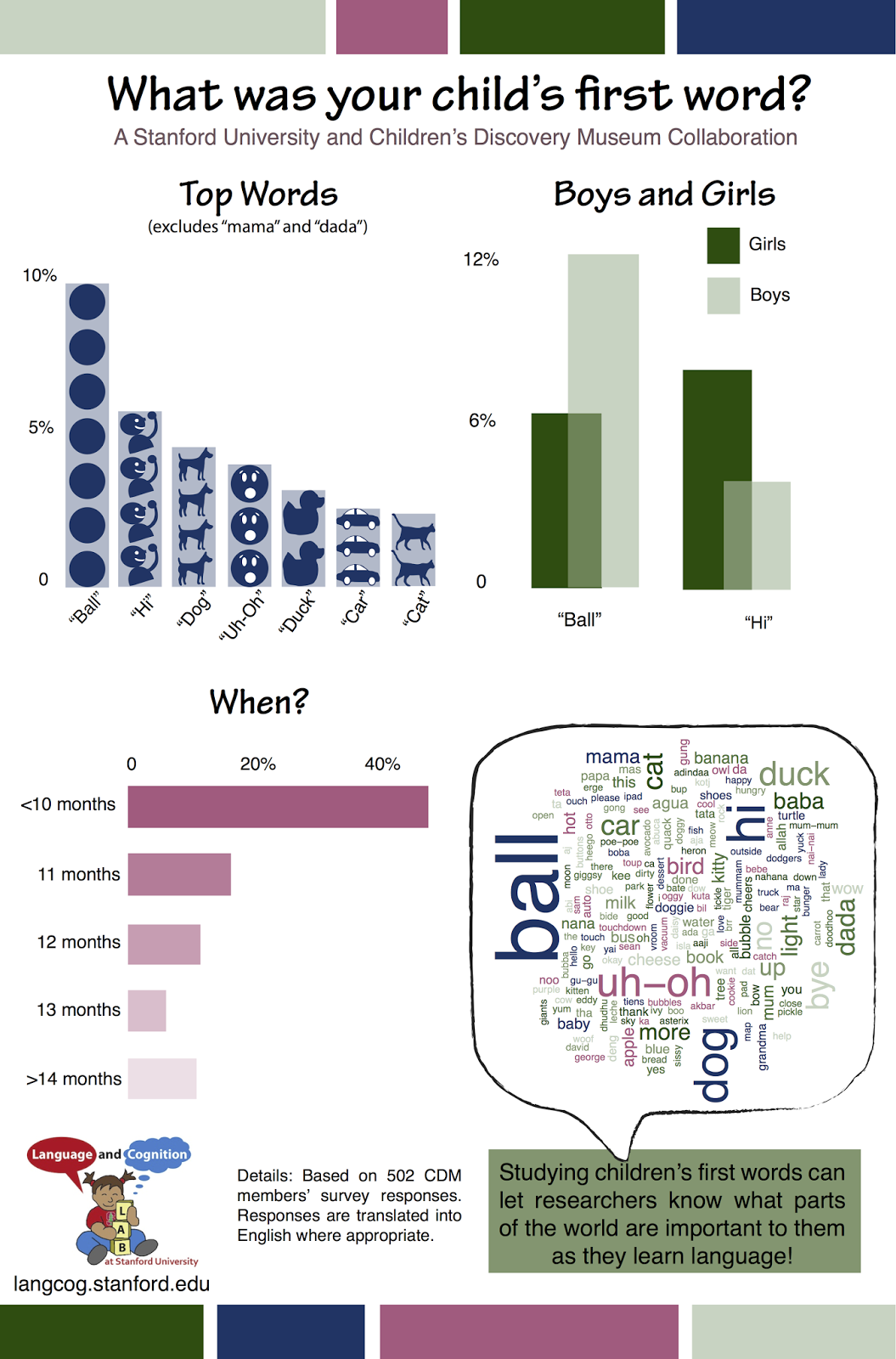
Here's the graphic we produced for CDM:


We were struck by a couple of features of the data, and the goal of this post is to talk a bit more about these, as well as some of other things that didn't fit in the graphic.

First, the distribution of words seemed pretty reasonable, with short, common words for objects ("ball," "car"), animals ("dog," "duck" – presumably from bathtime), and social routines ("hi"). The gender difference between "ball" and "hi" was also striking, reflecting some gender stereotypes – and some data – about girls' greater social orientation in infancy. Of course, we can't say anything about the source of such differences from these data!

Another interesting feature of the data was the age distribution we observed. On parent report forms like the CDI, parents often report that their children understand many words even in infancy, with the 75th percentile being reported to know 50 words at 8 months. While there is some empirical evidence for word knowledge before the first birthday, this 50 word number has always been surprising, and no one really knows how much wishful thinking it includes. The production numbers for the CDI are much lower, but still have a median value above zero for 10-month-olds. So is this overestimation? Probably depends on your standards. M, Mike's daughter, had something "word-like" at 10 months, but is only now producing "hi" as a 12-month-old (typical girl).

One possible confound in this reporting would be parents misremembering the age at which their child first produced a word, perhaps reporting systematically younger or older ages (or even ages rounded more towards the first birthday) as the first word recedes into the past. We didn't find evidence of this, however. The distribution of reported age of first word was the same regardless of how old the child was at the time of reporting:

Now on to some substantive analyses that didn't make it into the graphic. Grouping our responses into broad categories is a good way to explore what classes of objects, actions, etc., were the referents of first words. While many of the words we observed in parents’ responses were on the CDI, we had to classify some others ad-hoc, and still others we were unable to classify (we ended up excluding about 50 for a total sample of 454, 42% female). Here's a graph of the proportions in each category:
So no individual animal name dominated, but overall they were most frequent, followed by "games and routines" (including social routines like "hi" and "bye") and toys. People were next, followed by animal sounds.

There are some interesting ways to break this down further. Note that girls generally are a few months ahead, language-wise, so analyses of age and gender are a bit confounded. Here's our age distribution broken down by gender:
As expected, we see girls a bit over-represented in the youngest age bin and boys a little bit over-represented in the oldest bin.

That said, here are the splits by age:
and gender:
Overall, younger kids are similar to older kids, but are producing more names for people. Older kids were producing slightly more vehicle names and sounds, but this may be because the older kids skew more male (see gender graph, where vehicles are almost exclusively the provenance of male babies). The only big gender trends were 1) a preference for toys and action words for the males and 2) a general broader spread across different categories. This second trend could be a function of boys' tendency to have more idiosyncratic interests (in childhood at least, perhaps beyond).

Overall, these data give us a new way to look at early vocabulary, not at the shape of semantic networks within a single child, but at the variability of first words across a large population. We invite you to look at the data if you are interested! 

---
Thanks very much to Jenni Martin at CDM for her support of our research!

* What does that even mean? Is a word a word if no one understands or recognizes it? That seems pretty philosophically deep, but hard to assess empirically. We'll go with the first word that someone else, usually a parent, recognized as being part of communicating (or trying to communicate). 


Monday, August 11, 2014

Getting latex to work at journals

I got good news about a manuscript being accepted today, but I was reminded again how painful it can be to get journals to accept LaTeX source. Sometimes I wonder if I waste as much time in wrangling journals as I save in writing by using tex and bibtex.

I routinely have manuscripts bounced back by editorial assistants who ask "Why can't I edit your PDF? Can you send me the word source?" Hopefully policies like Elsevier's Your Paper Your Way and the PNAS equivalent, "express submission," will promote a new norm for first submissions.

For my own memory as much as anyone else, here are some tips for getting Elsevier's maddening EES to accept tex source:

  • Uploading an archive with all files never has worked for me, so I skip this step
  • Use elsarticle.cls and the included model5-names.bst for formatting and APA-style references
  • Upload both .bib AND .bbl files as supplementary information (this was the tricky one!) – why would this be necessary?
  • Upload all figures separately; PDF format has worked for me though EPS is requested.
Also, if you have uploaded a version of a file and then want to replace it, be careful to rename it. EES keeps the oldest version of a file so it will not update if you upload a newer version (totally idiotic).

Wednesday, July 30, 2014

I would have shocked myself

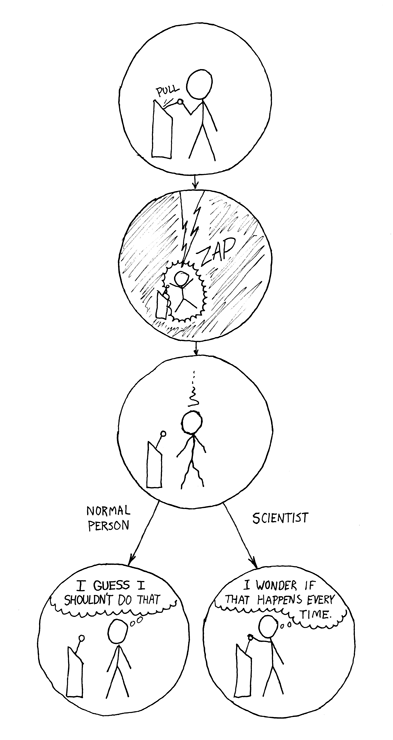
(One of my favorite xkcd cartoons. According to recent research, 
maybe we're all scientists? At least, we keep pulling the lever over and 
over again...)


Do people hate being alone with their thoughts so much that they will shock themselves to avoid thinking? In a series of studies, Wilson et al. (2014) asked people to spend time quietly thinking without distractions and concluded that people generally found the experience aversive. Others have reinterpreted this conclusion, but the general upshot is that people at least didn't find it particularly pleasurable. Several manipulations (e.g. planning the thing you were going to think about) also didn't make the experience much better. Overall this is a very interesting paper, and I really appreciated the emphasis on a behavior – mind wandering – that has received much more attention in the neuroscience literature than in psychology.

The part of the paper that got the most attention, however, was a study that measured whether people would give themselves an electric shock while they were supposed to be quietly thinking. The authors shocked the participants once and then checked to make sure that the participants found it sufficiently aversive to say they would pay money to avoid having it done to them again. But then when the participants were left to think by themselves, around two thirds of men and a quarter of women went and shocked themselves again, often several times. The authors interpret this finding as follows:
What is striking is that simply being alone with their own thoughts... was apparently so aversive that it drove many participants to self-administer an electric shock that they had earlier said they would pay to avoid.
Something feels wrong about this interpretation as it stands. Here are my two conflicting intuitions. First, I actually like being alone with my own thoughts. I sometimes consciously create time to space out and think about a particular topic, or about nothing at all. Second, I am absolutely certain I would have shocked myself.

I would have shocked myself at least once, but possibly five or more times. I might even have been the guy who shocked himself 190 times and had to get excluded from the study. Even when I said I would pay money to avoid having someone else shock me. I definitely would have done it to myself. Why? I don't really know.

There are many sensations that I would pay money not to have someone do to me: stick a paperclip under my fingernail, pluck out hairs from my beard, bite my nail to the quick. Yet I will sometimes do these things to myself, even though they are painful and I will regret it afterwards. The exploration of small, moderately painful stimuli is something that I do on a regular basis. (Other people do these things too). I am not sure why I do them, but I don't think it's because I hate being bored so much that I would rather be in pain.

Boredom and pain are not zero sum, in other words. Pain can drive boredom away, but the two can coexist as well. I don't do these things when I'm engaged in something else like reading the internet on my phone. But I do actually do them on a regular basis when I'm listening to a talk or thinking about a complicated paper.

I don't know why I cause myself minor pain sometimes. But it feels like there are at least two component reasons. One is some kind of automatic exploration (they happen when my mind is otherwise occupied, as the examples above show). But I also do these sorts of things in part because I want to see how they feel. Kind of like ripping off a hangnail or playing with a sharp knife. There's some novelty seeking involved, but doing them again and again isn't quite about novelty seeking; we've all had a hangnail or pulled out a hair. Perhaps it's about the exact sensation and the predictions we make – will it feel better or worse? Can I predict exactly what it will be like?

What I'm arguing is that these things are mysterious on any view of humans as rational agents. The Wilson paper doesn't sufficiently acknowledge this mystery, instead choosing to treat people as purely rational: they paid to avoid X, but then they do it anyway, it must be because X is better than Y. But there isn't a direct, utility-theoretic tradeoff between mind-wandering and electric shock. Consider if Wilson et al. had played Enya to participants and found they shocked themselves (which I bet I would have). Would they then conclude that Enya is so bad that people shock themselves to get away from her?


ResearchBlogging.org Wilson TD, Reinhard DA, Westgate EC, Gilbert DT, Ellerbeck N, Hahn C, Brown CL, & Shaked A (2014). Social psychology. Just think: the challenges of the disengaged mind. Science, 345, 75-77 PMID: 24994650

Tuesday, July 29, 2014

Are first words bound to specific contexts?

("Internet high five." From maniacworld.com).

It's so fun to watch the emergence of language. M just had her first birthday, and – though we still haven't seen much in the way of production beyond "brown bear" (see previous post) and maybe "yum" – she's starting to show some exciting signs of knowing some words. It's endlessly fascinating to gather evidence about her comprehension, but I'm continuously amazed at how tenuous my evidence is for any given word.*

In particular, I've been wondering for the past week or so whether M knows the meaning of the word/phrase "high five." She loves the swings at the playground, and really enjoys playing games while swinging. One day we started doing hand slaps (accompanied by me saying "high five"). After a couple of times playing this game, when I said "high five," she would raise her hands, even without the extra cue of me raising my hands. Word knowledge, right?

It turns out that one persistent question about first words is how contextually-bound they are: whether their meanings are general across contexts, or whether they apply only in specific cases. Some of this is a remnant of older, behaviorist analyses of early language – word A is a conditioned response to situation B – which don't seem to account for the data. Most people who study child language agree that early nouns like "dog" can be generalized across situations quite handily – in fact, overgeneralization is relatively common. But you still see references to "context-specific" language in textbooks and materials for parents (exampleexample). My goal here is to propose an alternative – rational – account of why much early language looks context specific, even though it's not.

I can see why ideas about context-specific language stick around. When I investigated M's "high five" knowledge further, I was disappointed. Although I could get her to give me a high five on the swings, I simply couldn't elicit the gesture in response to my words when we came home to the house. This looked to me a lot like "high five" was bound to the context of the swing set.

But here's another possibility, in two parts. Part one: Language comprehension for a one-year-old is hard. A well-known set of experiments by Stager & Werker (1998) suggest that even relatively small attentional demands can disrupt the encoding of speech. In their experiments, 14-month-olds (and even 8-month-olds) could distinguish the sounds "bih" and "dih." But the same age children had trouble learning to pair these sounds consistently with different pictures, even though they could do it just fine with more dissimilar words (e.g. "lif" and "neem"). 

Part two: When you have a hard comprehension task, context can make it easier. Contextual predictability effects have been very well studied in word recognition (example), with the caveat that context is typically defined as being the sentence in which a sound occurs. The basic idea is very Bayesian: a context creates a higher prior probability of a particular sound, which helps in identifying that sound from noisy perceptual input.

So perhaps contextual-boundedness effects in early child language have exactly the same source. When M recognizes "high five," it could be that she is getting a boost from its use in a familiar context, even if she could – in principle – recognize it in another context, given a sufficiently clear and unambiguous signal. Inspired by this idea, I tried asking her again at the house the other day. I said, "M! M! Can you give me a HIGH... FIVE?" in my best child-directed speech. She grinned and reached her hand up for the win. Of course, while I was figuring out my theory, perhaps she was generalizing...

---
* There are so many reasons why any uncontrolled individual test of comprehension doesn't provide good evidence for her knowledge.** For example, if I'm trying to figure out whether she knows the word "cat," I can't use a book where we have previously pointed to a cat photo, since she tends to come back to parts of the book we've attended to. On the other hand, if I find two new objects (a cat and a ball), typically one will be more exciting than the other. In some of our recent eye-tracking work, we've been finding that salience of this kind has an outsize effect on word recognition (echoing much earlier findings), and the best work on very early word knowledge explicitly measures and subtracts this salience bias.

** That's why experiments, I guess...