Thursday, June 25, 2026

Help me, but don't touch the paper!

As I’m discussing paper writing with more folks in the age of Claude Code and other coding assistants, we’re having more discussions about how to use these tools in writing. 

Per my earlier post, I don't want AI tools to "take away the good part" of my job, I want them to help with the bad parts. I'm finding it transformative that coding agents can help me iterate quickly through data munging tasks, navigate cluster scheduling challenges, and prototype experiments, just to name a few examples. They can also be very valuable for manuscript preparation, including finding typos, helping with formatting and reproducibility, and code review.

Agents are especially useful for Rmarkdown or Quarto-based reproducible writing. Writing reproducible papers is a great way to avoid typos and to quickly update your manuscript with new analyses. I teach this content and find it extremely helpful in my work. But getting a reproducible paper to compile can be very annoying, and I would like agents to help me (and my students and collaborators, who struggle with this step sometimes!). 

Here's my simple rule: agents should not directly touch the text of the paper. Paper text should be written by a human.* If agents write text, it's still far too easy for them to make things up (especially references) and to write text that is superficially correct but unmoored to the actual human research activities. 

So, how do you collaborate with an agent on a paper and guarantee it doesn't touch the text? Here is one workflow that's been working for me:

  • The paper is written in a git repository. You commit all changes you make to the paper. 
  • You ask the agent to do the work on a branch and make a pull request, following strict rules not to change text. 
  • You review merge the PR and have clear visibility (and an audit trail) for any changes. That way, if the agent does touch the text, you know where and when that happened.

Here's a Claude Code skill file that instantiates this workflow.

---

*Norms may shift in the future but for now, that's where I'll draw the hard line. 

Wednesday, April 22, 2026

Datapages for reusable (and pretty!) data sharing

[This post is joint with Mika Braginsky, a long-time collaborator on data-sharing and data-viz.]

Data sharing is both a critical scientific need and, increasingly, a mandate by many research funders. The FAIR principles – that data should be findable, accessible, interoperable, and reusable – are a critical guide to how data are shared. Yet even FAIR-compliant datasets in approved repositories are often shared in ad-hoc formats that are hard to reuse or to integrate with other data. In contrast, the most impactful datasets tend to be disseminated thoughtfully through dataset-specific or community-specific platforms. These “domain-specific data repositories” (this was our term from a previous blogpost!) create opportunities for creating data standards and ontologies that fit the needs of a particular community, research problem, or instrument type. They also allow opportunities for engagement through interactive visualizations. But custom repositories and pretty websites with nice visualizations are costly and complicated to create.

We are introducing a set of open-source tools and templates for easily creating datapages, interactive websites to disseminate data for broad reuse. Datapages are easy to deploy for a single project, but extensible enough to host large collections of related datasets. You can learn more and get started at https://datapages.github.io/.

Monday, April 20, 2026

Using AI to improve (not automate away) academic research

Everyone seems to be consumed with AI anxiety. Graduate students are wondering if they will be replaced by assistants, or if they themselves are using AI enough or using it "right". Researchers are wondering what it means to produce research if agents can write whole papers. Everyone is wondering how we will keep up with a literature that is moving ever faster. 

Everyone is feeling the pressure to do *more*: do more projects, produce more papers, review more papers. This has already resulted in negative impacts on the research space, for example the problems that conferences have in getting quality, non-automated reviewing for the huge volume of submissions they receive. 

We should think about what we can do that is *different.* We should try to use automation to be more efficient at the annoying parts of our jobs while leaving more time for discovering new knowledge. The key (fast-evolving, unresolved) issue is how AI models will change the frontier of what is scientifically possible. This varies from field to field and changes day by day, but my sense is that the rise of semi-autonomous agents will be very interesting for scaling up social and behavioral science.

Monday, February 16, 2026

An LLM-backed "socratic tutor" to replace reading responses

My hot take on college-level teaching is that reading responses are mostly a terrible assignment, and they're even worse in the age of AI. I'm piloting something a bit different with my co-instructor right now: a "socratic tutor" bot that asks students to answer open-ended socratic questions about a specific text and "passes" them when they show sufficient comprehension. Initial feedback from students in a first trial has been extremely positive, so I am thinking more about how this could be useful in the future, as well as some of the potential problems. LLMs are far from a panacea for education – they cause way more problems than they solve, at the moment! – but this might be an interesting use case. 

As an instructor, one major challenge is that you want people to read the assigned reading and engage with it so that what you do in class can build on this content in a meaningful way; some students would prefer not to (or just don't have time, or whatever). How do you solve this problem? Weekly quizzes are possible but they're time-consuming to make and give and annoying to grade; plus they reinforce a memorization mindset, rather than inviting students to engage. 

The humble reading response is a frequent alternative: you ask students to respond to, critique, or build on their readings, usually in a short response ranging from a paragraph to a page. At their best in a well-prepared seminar, the instructor reads these beforehand, synthesizes them, and calls on individual students to share their reactions. But in a larger course, often this synthesis is impossible – and so the reading response becomes an assignment that no one wants to write and that can be tedious to read at the level they deserve. Even worse, if you're not getting called out on your reaction, it's possible to "respond" to a reading without having read it. And that's even before you can ask an AI to write a response to a text that it has ingested at some point (or that you've pasted into its chat window). What do we do? 

Wednesday, July 23, 2025

Book review: Elusive Cures

 I'm normally an avid fiction reader, but this summer I've been on a non-fiction kick. I just finished listening to Nicole Rust's new book, Elusive Cures. The premise of the book is the simple, important question: why haven't we made more progress on understanding brain disorders using basic neuroscience? Rust's argument is that the kind of "domino chain" causal model that we use to understand many neural systems is simply mismatched to the nature of how complex systems work. Rust is a cognitive neuroscientist who is known for her work on vision and memory, but she does not lean on these areas in the book, instead broadly surveying the neuroscience of disorders including Alzheimer's, Parkinson's, and depression. 

Although I'm mostly a cognitive scientist these days, Rust's description of the forward causal model for neuroscience immediately felt familiar from from my grad school neuroscience training. These kinds of causal systems are the ones we've made the most progress on in cognition as well: we have pretty strong models of how visual object recognition, reading, and language processing unfold in time. In contrast, processes that unfold interactively over time, such as mood, are much harder to understand this way. 

I have often been skeptical of the application of complex dynamical systems theory to cognition, though Rick Dale's nice intro for the Open Encyclopedia of Cognitive Science did win me over somewhat. I agree that cognition is a complex dynamical system, but in practice such formalisms can often feel unconstrained. Many researchers using dynamical systems theories don't – for whatever reason – engage in the kind of systematic model comparison and evaluation that I believe is critical for cognitive modeling

I heard that same kind of skepticism in Rust's own writing, which made it even more compelling when she made the case for the critical importance of understanding the brain as a complex dynamical system. Her discussion of the role of homeostasis in brain systems in particular was inspiring. It made me wonder why we don't apply the concept of homeostasis more to reason about social systems as well – for example, how communities maintain their educational standards in the face of policy changes or interventions. It's always a pleasure when a book sparks this kind of reflection. 

In sum, I strongly recommend Elusive Cures. I found it thought-provoking and broad, with good descriptions of both individual research findings and sweeping trends. The book feels like the rare "popular" book that also effectively makes a forceful scientific argument. 

Wednesday, June 11, 2025

Two summer book recommendations

After a long stint primarily reading fiction, I've been on a non-fiction kick recently and just read two books that I would definitely recommend!

Persuasion in Parallel (2022) by Alexander Coppock, a political scientist at Yale, is a scholarly monograph on how political persuasion works. It's a delightful combination of large-scale replications, strong emphasis on effect estimation and causal inference, and really thoughtful discussion of mechanisms. It starts from a replication and re-analysis of Lord, Ross, and Lepper (1979), the seminal work on political persuasion, and goes on to replicate a whole host of more recent studies. Across all of them, the key take-home is that arguments about controversial topics (e.g., gun control, abortion, etc.) operate very similarly across people with very different views: they cause small changes in attitude in the direction of the arguments, regardless of the recipient's initial views. 

In statistical terms, there's very limited heterogeneity across groups in the effect of persuasive arguments. I really appreciated evidence on this heterogeneity question because often students' intuition in psychology is that everything differs based on sociodemographic characteristics; yet this intuition is rarely quantified or challenged. Coppock's analyses take a really important step in this direction. 

The book is short and quite readable (especially given how data-rich it is). It's also very up front about the limitations of the work. There's also a thought-provoking final chapter on Bayesian inference and rational models of belief change that makes a number of connections to computational cognitive science that I enjoyed. Despite being an academic, I am not the sort of person who will sit down on a weekend with a monograph from another discipline for fun; this book was an exception for me because of how interesting, important, and thorough the work is.

On a heavier note, Doctored (2025), by Charles Piller (an investigative reporter with Science), is a screed about scientific misconduct in Alzheimer's research. I'm intimately familiar with replication issues in psychology, but I was still totally horrified to read about the impacts of scientific fraud in the Alzheimer's field. Piller makes a very well-researched and thorough case, working with experts on fraud and scientific reviewers. While a critique of the book by an Alzheimer's authority questions how central the fraudulent work was to the field (Lancet review), I was convinced by the later chapters of Doctored that show how pervasive image falsification has been within the Alzheimer's research enterprise. It's just awful to think that many people have been in dangerous clinical trials due to research misconduct. 

The book was clearly written very fast as there is some redundancy between chapters and a bit of unnecessary stage-setting around various researchers' grandparents (perhaps reflecting a pivot from an earlier vision of the book where certain people were more important to the narrative). But the substance of the scientific critique is so compelling – and honestly terrifying – that I was more than happy to overlook a few minor weaknesses in the prose. Definitely recommend.

Tuesday, December 3, 2024

Four papers I'm sad never to have published

One of the saddest things in academic research is an abandoned project. You pour time, effort, and sometimes money into a piece of research, only to feel that it has not been released into the world to make an impact. Sometimes you don't finish an analysis or write a paper. But I would argue that the saddest situations are the projects that came closest to being published – these are "near misses."*

This sadness can also have practical consequences. If we abandon projects differentially because of their results – failing to report negative findings because of a belief that they would be uninteresting or hard to publish – then we get a bias in the published literature. We know this is true – but in this post I'm not going to focus on that. I'm thinking more about inadvertent near misses. The open science movement – and in particular the rise of preprints – has changed the field a lot in that these near misses are now visible again. So I'm writing this post in part to promote and discuss four projects that never saw journal publication but that I still love...

I'm a researcher but I'm also (maybe primarily) an advisor and mentor, and so this kind of thing happens all the time: a trainee comes into my lab, does a great project, writes a paper about it, and then moves on to a new position. Sometimes they stay in academia, sometimes they don't. Even if we submit the manuscript before they leave, however, it frequently happens that reviews come back after they are distracted by the next stage of their life. Unless I take over the writing process, things typically remain unpublished. 

But the worst thing is when I abandon my own work because I'm too busy doing all that advising and teaching (and also getting grants to do the next shiny thing). Sadly this has happened many times over the past 15 years or so that I've been a faculty member. I simply didn't have the fortitude to get the paper through peer review and so it lingers as something interesting but unrevised – and perhaps fatally flawed (depending on whether you trust the reviewers). Here are my four biggest regrets. 

1. A literature review on computational models of early language learning. This was the first chapter of my dissertation initially, and I revised it for a review journal, hoping to do something like Pinker's famous early review paper. It was reviewed by two people, one nativist and one empiricist. Both hated it, and I abandoned it in despair. I still like what I wrote, but it's very out of date now. 

2. A huge dataset on children's free-viewing of naturalistic third-person dialogue and how it relates to their word learning. I loved this one. These experiments were my very first projects when I got to Stanford – we collected hundreds of kids worth of eye-tracking data (with an eye-tracker bought with my very first grant) and we were able to show correlational relationships between free-viewing and word learning. We even saw a similar relationship in kids on the autism spectrum. This paper was rejected several times from good journals for reasonable reasons (too correlational, kids with ASD were not well characterized). But I think it has a lot of value. (The data are now in Peekbank, at least).

(Graph showing big developmental differences in free viewing, specifically for a moment at which you had to follow an actor's gaze to see what they were talking about in the video).

3. A large set of experiments on reference games. Noah Goodman and I created the Rational Speech Act  (RSA) model of pragmatic processing and this was a big part of my early research at Stanford. I spent a ton of time and money doing mechanical turk experiments to try to learn more about the nature of the model. This manuscript includes a lot of methodological work on paradigms for studying pragmatic inference online as well as some clever scenarios to probe the limits (there were 10 experiments overall!). Sadly I think I tried to make the manuscript more definitive than it should have been – by the time I finally submitted it, RSA already had many variants, and some of the formal work was not as strong as the empirical side. So reviewers who disliked RSA disliked it, and reviewers who liked RSA still thought it needed work. 

4. A simplified formal model of teaching and learning. This one was an extension of the RSA model for teaching and learning scenarios, trying to get a handle on how teachers might change their messages based on the prior beliefs and/or knowledge of the learners. I was really proud of it, and it shapes my thinking about the dynamics of teaching to this day. Lawrence Liu started the project, but I did a ton more analysis several years later in hopes of making a full paper. Sadly, it was rejected once – reviewers thought, perhaps reasonably, that the policy implications were too big a stretch. By the time I submitted it to another journal, a bunch of other related formal work had appeared in the computer science literature. Reviewers the second time asked for more simulations, but I was out of time and the code had gotten quite stale because it depended on a very specific tech stack. 

I hope someone gets a little pleasure or knowledge from these pieces. I loved working on all four of them!

---- 

* I just learned that there is a whole literature on the psychology of near misses, for example in gambling or with respect to emotions like relief and regret.

Some thoughts on ManyBabies 4

 [repost from Bluesky]

Three ManyBabies projects - big collaborative replications of infancy phenomena - wrapped up this year. The first paper came out this fall. I thought I'd take this chance to comment on what I make of the non-replication result.

https://onlinelibrary.wiley.com/doi/full/10.1111/desc.13581

First, off - this study was a SUCCESS! We got the community together to plan a replication study and then we got 37 labs and 1000 babies to do a complicated study and we pulled it off. That's a huge win for team science! Major kudos to Kelsey, Francis, and Kiley.

In case you're wondering about the status of the other projects, here's a summary slide (already shared right after ICIS). MB3-4 yielded null effects; MB2 is complicated... preliminary analysis shows the predicted effect but an even bigger, unpredicted effect in the control condition.


Turning back to MB4, we were interested in the classic "helper hinderer" phenomenon. In these studies, babies have been shown to choose an object that "helps" over one that "hinders" a third one. A nice meta-analysis by Margoni & Surian (2018) confirms that this effect is variable across labs but has been found quite a lot of times.  Data from this MA and an update by Alvin Tan are on metalab: langcog.github.io/metalab/. MB4 ran a "straightforward" best practices replication, but with standardized video displays and both a social and non-social condition. Overall, there were no preferences for helpers or hinderers at any age and for either condition.

So what's going on? Well, the initial success (and various replications in the meta-analysis) could have been false positives or contained some confound leading to success. Or there might be some key difference in the replication leading babies to fail in this particular version. There are other possibilities (bad implementation or bad measurement, for example) but I think these are less likely, given the general care that was taken in the project and the large sample size, which allows detection of effects much smaller than the original effect.

Some people will jump to the interpretation that this study shows that the original finding was incorrect (and hence that the other replications were incorrect as well, and the earlier non-replications were right). This one possibility - but we shouldn't be so quick to jump to conclusions. Another possibility is that the *particular* instantiation of helper-hinderer in MB4 is just not a good one. Maybe the stimuli are too fast, for example (some people have suggested this explanation). For all the size of the sample of participants in MB4, it's just a *single* stimulus sample.

In collaborative replication projects, I have an increasing appreciation of Tal Yarkoni's point about the critical need for sampling stimuli (and paradigms) from the broader space in order to achieve generalizability. One stimulus or paradigm can always be idiosyncratic. In a recent paper, Holzmeister et al. break down heterogeneity into population, procedural, and analytic heterogeneity. They find that population is low, but procedural and (likely) analytic heterogeneity is very high across various multi-lab studies.  That conclusion fits with what we saw in ManyBabies 1 where procedure did really matter - different methods yielded quite different effect sizes - but population didn't seem to matter as much, modulo known moderators like age and native language.

A very reasonable alternative interpretation of MB4 - instead of the false positive interpretation - is that we simply do not know *how* to elicit the helper-hinderer effect reliably, even if it is true. This "stimulus variability" explanation is not a very positive conclusion - lots of experts in the field sat around and tried to create a paradigm to elicit this finding and failed. The best case is that we don't as a field have processes for finding stimuli that elicit particular effects. The stimulus variability explanation is really different than saying that the original phenomenon is a false positive. But I think we really need to keep both explanations on the table at the moment, as uncomfortable as that may be.

In sum, I'm really enthusiastic about MB4. It's a key success for team science in infancy research, and it's also a valuable datapoint for understanding the helper-hinderer phenomenon. It's just not the end of the story...

PS: I think everyone should give HUGE props to Kiley Hamlin for pursuing this project to the end with massive dedication and openness to the result, even though it calls into question some of her previous work. That is what I call true scientific bravery.

Monday, March 27, 2023

Domain-specific data repositories for better data sharing in psychology!

Data sharing is a critical part of ensuring a reproducible and robust research literature. It's also increasingly the law of the land, with new federal mandates taking effect in the US this year. How should psychologists and other behavioral scientists share their data? 

Repositories should clearly be FAIR - findable, accessible, interoperable, and reusable. But here's the thing - most data on a FAIR repository like the Open Science Framework (which is great, btw), will never be reused. It's findable and accessible, but it's not really interoperable or reusable. The problem is that most psychological data are measurements of some stuff in some experimental context. The measures we use are all over the place. We do not standardize our measures, let alone our manipulations. The metadata are comprehensible but not machine readable. And there is no universal ontology that lets someone say "I want all the measurements of self-regulation on children that are posted on OSF." 

What makes a dataset reusable really depends on the particular constructs that it measures, which in turn depends on the subfield and community those data are being collected for. When I want to reuse data, I don't want data in general. I want data about a specific construct, from a specific instrument, with metadata particular to my use field. Such should be stored in repositories specific to that measure, construct, or instrument. Let's call these Domain Specific Data Repositories (DSDRs). DSDRs are a way to make sure data actually are interoperable and actually do get reused by the target community.

Why do LLMs learn so much slower than humans?


How do we compare the scale of language learning input for large language models vs. humans? I've been trying to come to grips with recent progress in AI. Let me explain two illustrations I made to help.

Recent progress in AI is truly astonishing, though somewhat hard to interpret. I don't want to reiterate recent discussion, but @spiantado has a good take in the first part of lingbuzz.net/lingbuzz/007180; l like this thoughtful piece by @MelMitchell1 as well: https://www.pnas.org/doi/10.1073/pnas.2300963120.

Many caveats still apply. LLMs are far from perfect, and I am still struggling with their immediate and eventual impacts on science (see prior thread). My goal in the current thread is to think about them as cognitive artifacts instead.

For cognitive scientists interested in the emergence of intelligent behavior, LLMs suggest that some wide range of interesting adaptive behaviors can emerge given enough scale. Obviously, there's huge debate over what counts as intelligent, and I'm not going to solve that here. 

But: for my money, we start seeing *really* interesting behaviors at the scale of GPT3. Prompting for few shot tasks felt radically unexpected and new, and suggested task abstractions underlying conditional language generation. At what scale do you see this? 

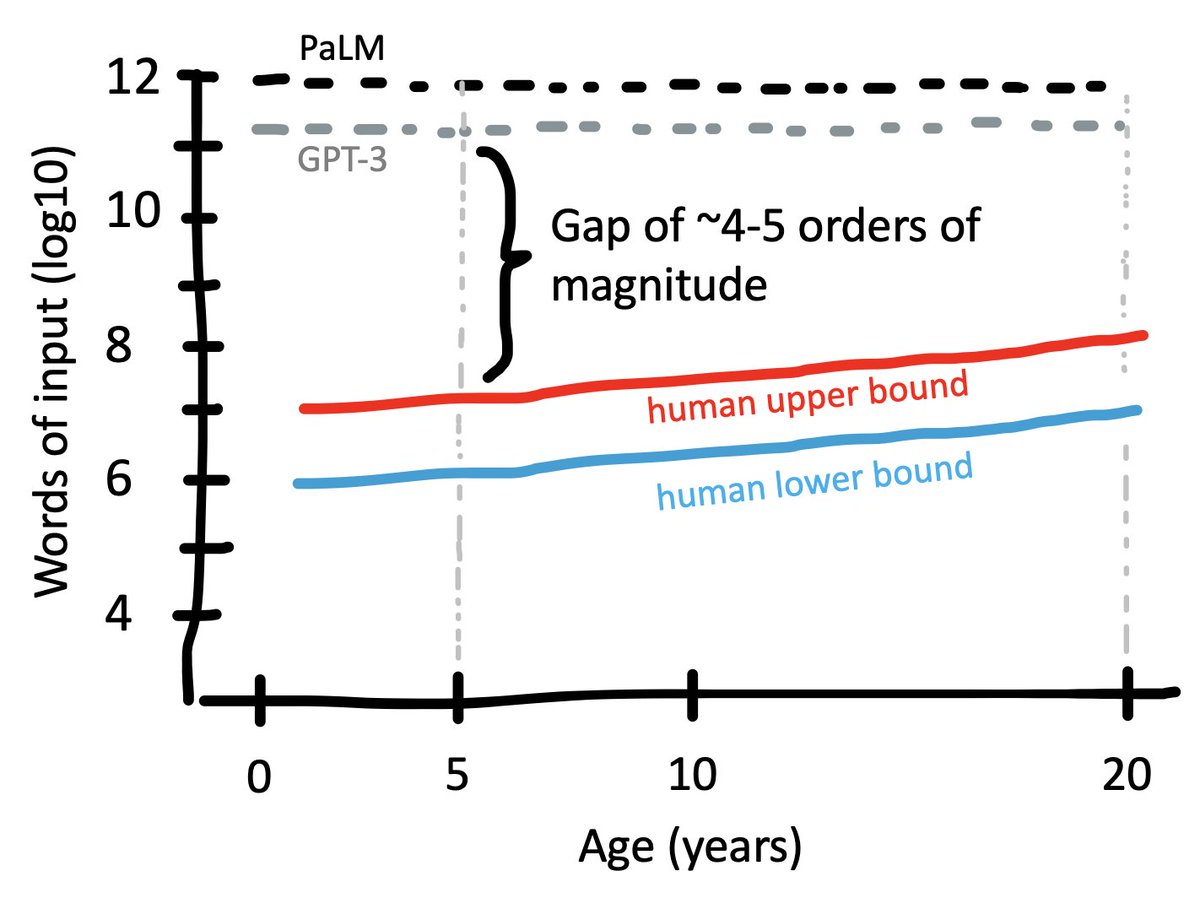
GPT-3 was trained on 500 billion tokens (= .75 words). So that gives us ~4e11 words. PaLM and Chinchilla are both trained on around 1e12 words. We don't know the corpus size for GP4-4 (!?!). How do these numbers compare with humans? 

Let’s start with an upper bound. A convenient approximation is 1e6 words per month for an upper bound on spoken language to a kid (arxiv.org/pdf/1607.08723…, appendix A or pnas.org/doi/abs/10.107…). That's 2e8 words for a 20 year old. How much could they read?

Assume they start reading when they’re 10, and read a 1e5-word book/week. That’s an extra 5e6 million words per year. Double that to be safe and it still only gets us to 3e8 words over 10 years.
Now let's do a rough lower bound. Maybe 1e5 words per month for kids growing up in a low-SES environment with limited speech to children (onlinelibrary.wiley.com/doi/epdf/10.11…). We don't get much of a literacy boost. So that gives us 5e6 by age 5 and 2e7 by age 20. 

That "lower bound" five year old can still reason about novel tasks based on verbal instructions - especially once they start kindergarten! 

The take-home here is that we are off by 4-5 orders of input magnitude in the emergence of adaptive behaviors.


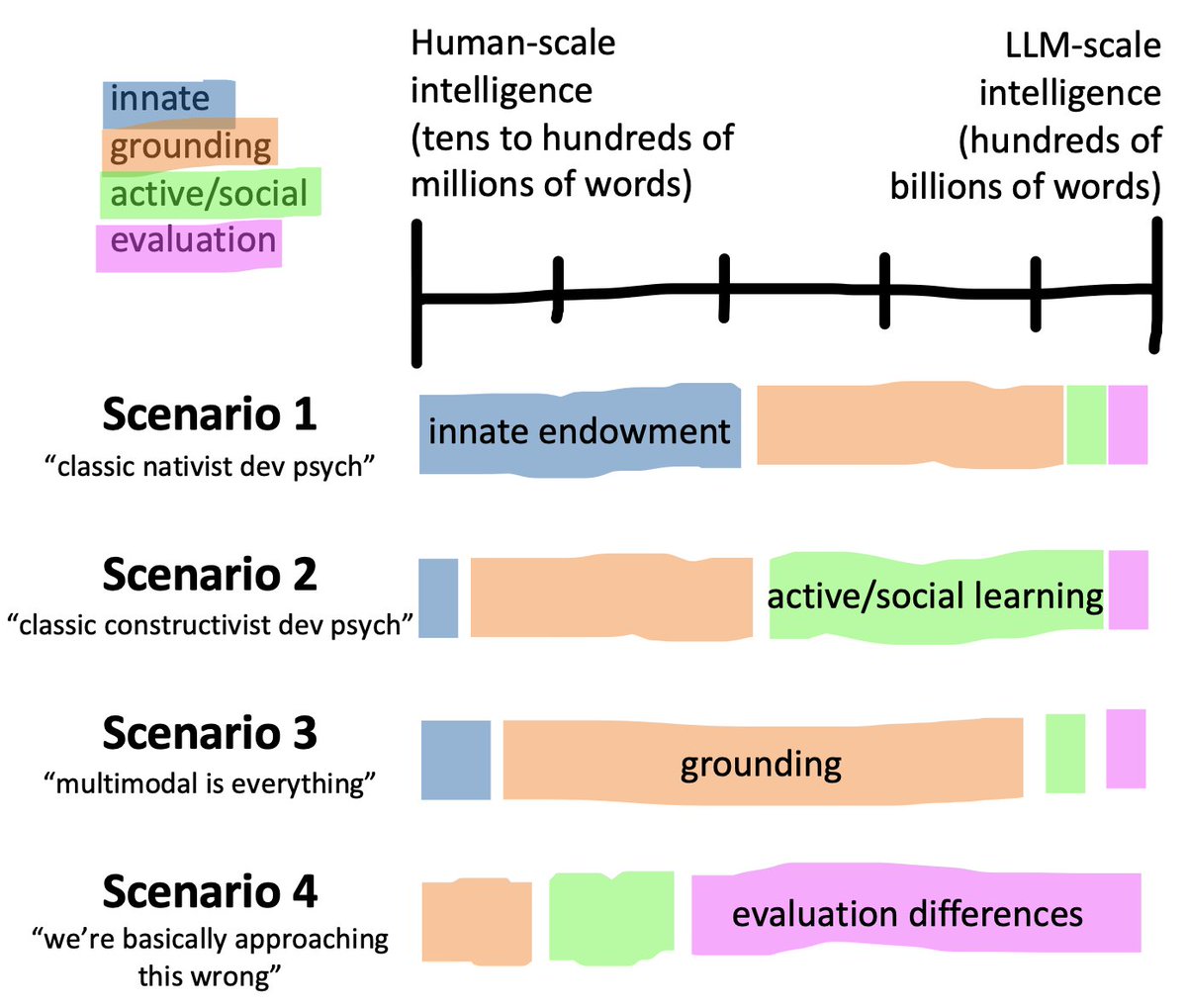
The big cognitive science question is - which factors account for that gap? I'll think about four broad ones. 

Factor 1: innate knowledge. Humans have SOME innate perceptual and/or conceptual foundation. The strongest version posits "core knowledge" of objects, agents, events, sets, etc. which serve to bootstrap further learning. People disagree about whether this is true.

Factor 2: multi-modal grounding. Human language input is (often) grounded in one or more perceptual modalities, especially for young children. This grounding connects language to rich information for world models that can be used for broader reasoning.

Factor 3: active, social learning. Humans learn language in interactive social situations, typically curricularized to some degree by the adults around them. After a few years, they use conversation to elicit information relevant to them.

Factor 4: evaluation differences. We're expecting chatGPT to reason about/with all the internet's knowledge, and a five year old just understand a single novel theory of mind or causal reasoning task. Is comparison even possible?

So of course I don't know the answer! But here are a few scenarios for thinking this through. Scenario 1 is classic nativist dev psych: innate endowment plus input make the difference. You use core knowledge to bootstrap concepts from your experience. 


Scenario 2 is more like modern rational constructivism. Grounded experience plus a bunch of active and social learning allow kids to learn about the structure of the world even with limited innate knowledge.

I hear more about Scenario 3 in the AI community - once we ground these models in perceptual input, it's going to be easier for them to do common-sense reasoning with less data. And finally, of course, we could just be all wrong about the evaluation (Scenario 4).

As I said, I don't know the answer. But this set of questions is precisely why challenges like BabyLM are so important (babylm.github.io).

AI for psychology workflows hackathon - a report

[reposted from twitter]

My lab held a hackathon yesterday to play with places where large language models could help us with our research in cognitive science. The mandate was, "how can these models help us do what we do, but better and faster."

Some impressions:🧵

Whatever their flaws, chat-based LLMs are astonishing. My kids and I used ChatGPT to write birthday poems for their grandma. I would have bet money against this being possible even ten years ago.

But can they be used to improve research in cognitive science and psychology?

1. Using chat-based agents to retrieve factual knowledge is not effective. They are not trained for this and they do it poorly (the "hallucination problem"). Ask ChatGPT for a scientist bio, and the result will be similar but with random swaps of institutions, dates, facts, etc.

2. A new generation of retrieval-based agents are on their way but not here yet. These will have a true memory where they can look up individual articles, events, or entities rather than predicting general gestalts. Bing and Bard might be like this some day, but they aren't now.

3. Chat-based agents can accomplish pretty remarkable text formatting and analysis, which has applications in literature reading and data munging. E.g., they can pull out design characteristics from scientific papers, reformat numbers from tables, etc. Cool opportunities. These functions are critically dependent on long prompt windows. Despite GPT-4's notionally long prompt length, in practice we couldn't get more than 1.5k tokens consistently. That meant that pre-parsing inputs was critical, and this took too much manual work to be very useful. 

4. A massive weakness for scientific use is that cutting-edge agents cannot easily be placed in a reproducible scientific pipeline. Pasting pasting text into a window is not a viable route for science. You can get API access but without random seeds, this is not enough. (We got a huge object lesson in this reproducibility issue yesterday when OpenAI declared that they are retiring Codex, a model that is the foundation of a large number of pieces of work on code generation in the past year. This shouldn't happen to our scientific workflows.) Of course we could download Alpaca or some other open model, set it up, and run it as part of a pipeline. But we are cognitive scientists, not LLM engineers. We don't want to do that just to make our data munging slightly easier!

5. Chat agents are not that helpful in breaking new ground. The problem is that, if you don't know the solution for a problem, then you can't tell whether the AI did it right, or even is going in the right direction!  Instead, the primary use case seems to be helping people accomplish tasks they *already know how to do*, but to do them more effectively and faster. If you can check the answer, then the AI can produce a candidate answer to check.

6. It was very easy for us to come up with one-off use-cases that could be very helpful (e.g., help me debug this function, help me write this report or letter), and surprisingly hard to come up with cases that could benefit with creating automated workflows. At small scale, using chat AI to automate research tasks is trading one task (e.g., annotating data) for more menial and annoying ones (prompt engineering and data reformatting so that the AI can process it). This is ok for large problems, but not small and medium ones.

7. Confidence rating is a critical functionality that we couldn't automate reliably. We need AI to tell us when a particular output is low confidence so that it can be rechecked.

In sum: Chat AI is going to help us be faster at many tasks we already know how to do, and there are a few interesting scientific automation applications that we found. But for LLMs to change our research, we need better engineering around reliability and reproducibility.

Thursday, February 16, 2023

Why do hybrid meetings suck?

I tried rendering this post in Quarto, which is not blogger-compatible, but I'm including the link here: rpubs.com/mcfrank/hybrid.

Sunday, February 21, 2021

Methodological reforms, or, If we all want the same things, why can't we be friends?

 (tl;dr: "Ugh, can't we just get along?!" OR "aspirational reform meet actual policy?" OR "whither metascience?")


This post started out as a thread about the tribes of methodological reform in psychology, all of whom I respect and admire. Then it got too long, so it became a blogpost. 

As folks might know, I think methodological reform in psychology is critical (some of my views have been formed by my work with the ManyBabies consortium). For the last ~2 years, I've been watching two loose groups of methodological reformers get mad at each other. It has made me very sad to see these conflicts because I like all of the folks involved. I've actually felt like I've had to take a twitter holiday several times because I can't stand to see some of my favorite folks on the platform yelling at each other. 

This post is my - perhaps misguided - attempt to express appreciation for everyone involved and try to spell out some common ground.

Monday, February 8, 2021

Transparency and openness is an ethical duty, for individuals and institutions

(tl;dr: I wrote an opinion piece a couple of years ago - now rejected - on the connection between ethics and open science. Rather than letting it just get even staler than it was, here it is as a blog post.)

In the past few years, journals, societies, and funders have increasingly oriented themselves towards open science reforms, which are intended to improve reproducibility and replicability. Typically, transparency policies focus on open access to publications and the sharing of data, analytic code, and other research products. 

Many working scientists have a general sense that transparency is a positive value, but also have concerns about specific initiatives. For example, sharing data often carries confidentiality risks that can only be mitigated via substantial additional effort. Further, many scientists worry about personal or career consequences from being “scooped” or having errors discovered. And transparency policies sometimes require resources that are not be available to researchers outside of rich institutions. 

I argue below that despite these worries, scientists have an ethical duty to be open. Further, where this duty is in conflict with scientists' other responsibilities, we need to lobby our institutions – universities, journals, and funders – to mitigate the costs and risks of openness.

Friday, October 23, 2020

Against reference limits

Many academic conferences and journals have limits on the number of references you can cite. I want to argue here that these limits make no sense and should be universally abolished

To be honest, I kind of feel like I should be able to end this post here, since the idea seems so eminently sensible to me. But here's the positive case: If you are doing academic research of any type, you are not starting from scratch. It's critical to acknowledge antecedents and background so that readers can check assumptions. Some research has less antecedent work in its area, other research has more, and so a single limit for all articles doesn't make sense. More references allow readers to understand better where an article falls in the broader literature.

Monday, March 2, 2020

Advice on reviewing

(Several people I work with have recently asked me for reviewing advice, so I thought I'd share my thoughts more broadly.)

Peer review – organized scrutiny of scientific work prior to publication – is a critical part of our current scientific ecosystem. But I have heard many of the peer review horror studies out there and experienced some myself. The peer review ecosystem could be improved – better tracking and sharing of peer review, better credit assignment, more fair allocations of review requests, better online systems for editors and reviewers, to name a few.*

Should we have peer review at all? In my view, peer review is primarily a filter that limits the amount of truly terrible work that appears in reputable journals (e.g., society publications, high-ranked international outlets). Don't get me wrong: plenty of incorrect, irreproducible, and un-replicable science still appears in print! But there are certain minimal standards that peer review enforces – published work typically ends up conforming to the standards of its field, even if those standards themselves could be improved. Without peer review, more of this terrible work would appear and there would be even more limited cues for distinguishing the good from the bad.** To paraphrase, it's the worst solution to the problem of quality control in science – except for all the others!

So all in all I'm an advocate for peer review.

Tuesday, November 5, 2019

Letter of recommendation: Attack of the Psychometricians

(tl;dr: It's letter of recommendation season, and so I decided to write one to a paper that's really been influential in my recent thinking. Psychometrics, y'all.)

To whom it may concern:

I am writing to provide my strongest recommendation for the paper, "Attack of the Psychometricians" by Denny Borsboom (2006). Reading this paper oriented me to a rich tradition of psychometric modeling – but more than that, it changed my perspective on the relationship between psychological measurement and theory. (It also taught me to use the term "sumscore"* as an insult). I urge you to consider it for a position in your reading list, syllabus, or lab meeting.

I first met AotP (or Attack!, as I like to call it) via a link on twitter. Not the most auspicious beginning, but from a quick skim on my phone, I could tell that this was a paper that needed further study.

The paper presents and discusses what it calls the central insight of psychometrics: that "measurement does not consist of finding the right observed score to substitute for a theoretical attribute, but of devising a model structure to relate an observable to a theoretical attribute." In other words, the goal is to make models that link data to theoretical quantities of interest. What this means is that measurement is essentially continuous with theory construction. By creating and testing a good measurement model, you're creating and testing a key component of a good theory.

Tuesday, October 8, 2019

Confounds and covariates

(tl;dr: explanation of confounding and covariate adjustment)

Every year, one of the trickiest concepts for me to teach in my experimental methods course is the difference between experimental confounds and covariates. Although this distinction seems simple, it's pretty deeply related to the definition of what an experiment is and why experiments lead to good causal inferences. It's also caught up in a number of methodological problems that come up again and again in my class. This post is my attempt to explain the distinction and how it relates to different problems and cultural practices in psychology.

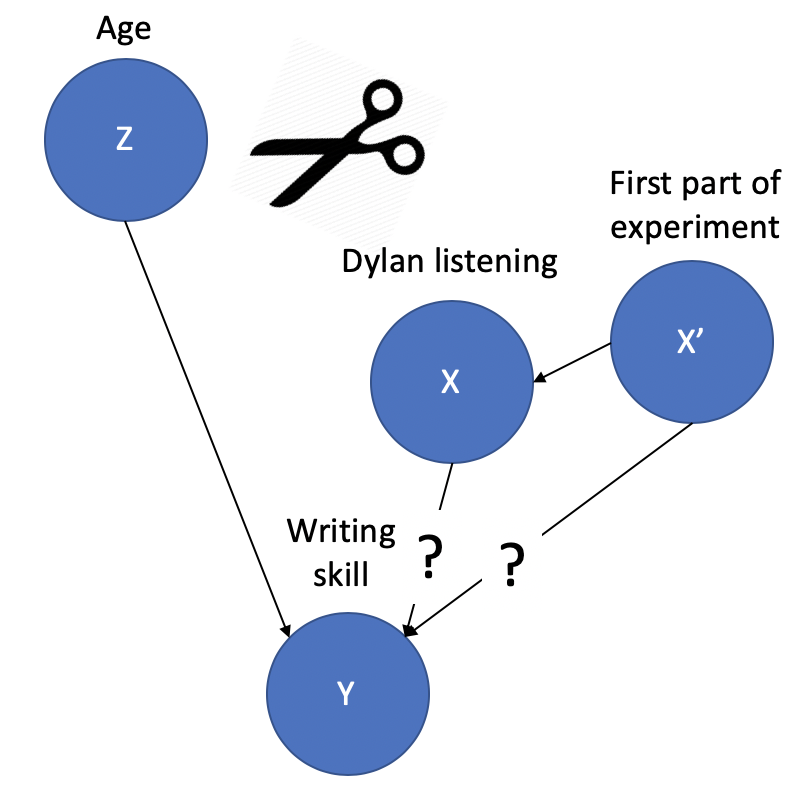
Throughout this post, I'll use a silly example. My first year of graduate school, I got distracted from my actual research by the hypothesis that listening to music with lyrics decreased my ability to write papers for my classes. I'll call this the "Bob Dylan" hypothesis, since I was listening to a lot of Dylan at the time. Let's represent this by the following causal diagram.


Our outcome is writing skill (Y) and our predictor is Dylan listening (X). The edge between them represents a hypothesized causal relationship. Dylan is hypothesized to affect writing skill, and not vice versa. (These kinds of diagrams are called causal graphical models*).

Observational Studies and Experiments

Suppose we did an observational study where we measured each of these variables in a large population. Assume we came up with some way to sample people's writing, get a measure of whether they either were or weren't listening to lyric-heavy music at the time, and assess the writing sample's quality. We might find that Y was correlated with X, but in a surprising direction: listening to Dylan would be related to better writing.

Can we make a causal inference in this case? If so, we could get rich promoting a Dylan-based writing intervention. Unfortunately, we can't – correlation doesn't equal causation here, because there is (at least one) confounding third variable: age (Z). Age is positively related to both Dylan listening and writing skill in our population of interest. Older people tend to be good writers and also tend to be more into folk rockers; I'm not even going to put a question mark on this edge because I'm pretty sure this is true.


But: the causal relationship of age to our other two variables means that variation in Z can induce a correlation in X and Y, even in the absence of a true causal link. We can say that age is a confound in estimating the Dylan-writing skill relationship: it's a variable that is correlated with both our predictor and our outcome variables.

To get gold-standard evidence about causality, we need to do an experiment. (We won't discuss statistical techniques for inferring causality, which can be useful but don't give you gold standard evidence anyway; review here).

Experiments are when we intervene on the world and measure the consequences. Here, this means forcing some people to listen to Dylan. In the language of graphical models, if we control the Dylan listening, that means that variable X is causally exogenous. (Exogenous means that it's not caused by anything else in the system). We "snipped" the causal link between age and Dylan listening.


So now we can "wiggle" the Dylan listening variable – change it experimentally – and see if we detect any changes in writing skill. We do this by randomly assigning individuals to listen to Dylan or not and then measuring writing during the assigned listening (or non-listening) period. This is a "between-subjects" design. We can use our randomized experiment to get a measure of the average treatment effect of Dylan, the size of the causal effect of the intervention on the outcome. In this simple experiment, the ATE is estimated by the regression Y ~ X (for ease of exposition, I'm not going to discuss so-called mixed models, which model variation across subjects and/or experimental items). That's the elegant logic of randomized experiments: the difference between condition gives you the average effect.

Confounds 

Let's consider an alternate experiment now. Suppose we did the same basic procedure, but now with a "within-subjects" design where participants do both the Dylan treatment and the control, in that order. This experiment is flawed, of course. If you observe a Dylan effect, you can't rule out the idea that participants got tired and wrote worse in the control condition because it always came second.

Order (Dylan first vs. control first; notated X') is an experimental confound: a variable that is created in the course of the experiment that is both causally related to the predictor and potentially also related to the outcome. Here's how the causal model now looks:


We've reconstructed the same kind of confounding relationship we had with age, where we had a variable (X') that was correlated both with our predictor (X) and our outcome (Y)! So...

What should we do with our experimental confounds? 

Option 1. Randomize. Increasingly, this is my go-to method for dealing with any confound. Is the correct answer on my survey confounded with response side? Randomize what side the response shows up on! Is order confounded with condition? Randomize the order you present in! Randomization is much easier now that we program many of our experiments using software like Qualtrics or code them from scratch in JavaScript.

The only time you really get in trouble with randomization is when you have a large number of options, a small number of participants, or some combination of the two. In this case, you can end up with unbalanced levels of the randomized factors (for example, ten answers on the right side and two on the left). Averaging across many experiments, this lack of balance will come out in the wash. But in a single experiment, it can really mess up your data – especially if your participants notice and start choosing one side more than the other because it's right more often. For that reason, when balance is critical, you want option 2.

Option 2. Counterbalance. If you think a particular confound might have a significant effect on your measure, balancing it across participants and across trials is a very safe choice. That way, you are guaranteed to have no effect of the confound on your average effect. In a simple counterbalance of order for our Dylan experiment, we manipulate condition order between subjects. Some participants hear Dylan first and others hear Dylan second. Although technically we might call order a second "factor" in the experiment, in practice it's really just a nuisance variable, so we don't talk about it as a factor and we often don't analyze it (but see Option 3 below).

In the causal language we have been using, counterbalancing allows us to snip out the causal dependency between order and Dylan. Now they are unconfounded (uncorrelated) with one another. We've "solved" a confound in our experimental design. Here's the picture:


Counterbalancing doesn't always work, though. It gets trickier when you have too many levels on a variable (too many Dylan songs!) or multiple confounding variables. For example, if you have lots of different nuisance variables – say, condition order, what writing prompt you use for each order, which Dylan song you play – it may not be possible to do a fully-crossed counterbalance so that all combinations of these factors are seen by equal numbers of participants. In these kinds of cases, you may have to rely on partial counterbalancing schemes or latin squares designs, or you may have to fall back on randomization.

Option 3. Do Options 1 and 2 and then model the variation. This option was never part of my training, but it's an interesting third option that I'm increasingly considering.** That is, we are often faced with the choice between A) a noisy between-participants design and B) a lower-noise within-participants design that nevertheless adds noise back in via some obvious order effect that you have to randomize or counterbalance. In a recent talk by Andrew Gelman, he suggested that we try to model these as covariates, to reduce noise. This seems like a pretty interesting suggestion, especially if the correlation between them and the outcome is substantial.***

Covariates

Going back to our example, now we have two variables – age and order – that are no longer confounded with our primary relationship of interest (i.e., Dylan and writing). But they may still be related to our outcome measure. Here's what the picture looks like, repeated from above.


Even if they are not confounding our experimental manipulation, age and experimental condition order may still be correlated with our outcome measure, writing skill. How does this work? Well, the average treatment effect of Dylan on writing is still given by the regression Y ~ X.  But we also know that there is some variance in Y that is due to X' and Z.

That's because age and order are covariates: they may – by virtue of their potential causal links with the outcome variable – have some correlation with outcomes, even in a case where the predictor is experimentally manipulated. This should be intuitive for the external (age) covariate, but it's true for both: they may account for variance in Y over and above that controlled by the experimental manipulation of X.

What should we do about our covariates? 

Option 1. Nothing! We are totally safe in ignoring all of our covariates, regressing Y on X and treating the estimate as an unbiased estimate of the the effect (the ATE). This is why randomization is awesome. We are guaranteed that, in the limit of many different experiments, even though people with different ages will be in the different Dylan conditions, this source of variation will be averaged out.

The first fallacy of covariates is that, because you have a known covariate, you have to adjust for it. Not true. You can just ignore it and your estimate of the ATE is unbiased. This is the norm in cognitive psychology, for example: variation between individuals is treated as noise and averaged out. Of course, there are weaknesses in this strategy – you will not learn about the relationship of your treatment to those covariates! – but it is sound.

Option 2. If you have a small handful of covariates that you believe are meaningfully related to the outcome, you can plan in advance to adjust for them in your regression. In our Dylan example, this would be a pre-registered plan to add Z as a predictor: Y ~ X + Z. If age (Z) is highly correlated with writing ability (Y), then this will give us a more precise estimate of the ATE, while remaining unbiased.

When should we do this? Well, it turns out that you need a pretty strong correlation to make a big difference. There's some nice code to simulate the effects of covariate adjustment on precision in this useful blogpost on covariate adjustment; I lightly adapted it. Here's the result:


Root mean squared error (RMSE; lower RMSE means greater precision, in other words) is plotted as a function of the sample size (N). Different colors show the increase in precision when you control for covariates with different levels of correlation with the outcome variable. For low levels of correlation with the covariate, you don't get much increase in precision (pink and red lines). Only as the correlation is .6 or above do we see noticeable increases in precision; and it only really makes a big difference with correlations in the range of .8.

Considering these numbers in light of our Dylan study, I would bet that age and writing skill are not correlated with writing skill > .8 (unless we're looking at ages from kindergarten to college!). I would guess that in an adult population this correlation would be much, much lower. So maybe it's not worth controlling for age in our analyses.

And the same is probably true for order, our other covariate. Although perhaps we do think that our order has a strong correlation with our skill measure. For example, maybe our experiment is long and  there are big fatigue effects. In that case, we would want to condition.

So these are are options: if the covariate is known to be very strong, we can condition. Otherwise we should probably not worry about it.

What shouldn't we do with our covariates?

Don't condition on lots and lots of covariates because you think they are theoretically important. There are lots of things that people do with covariates that they shouldn't be doing. My personal hunch is that this is because a lot of researchers think that covariates (especially demographic ones like age, gender, socioeconomic status, race, ethnicity, etc.) are important. That's true: these are important variables. But that doesn't mean you need to control for them in every regression. This leads us to the second fallacy.

The second fallacy of covariates is that, because you think covariates are in general meaningful, it is not harmful to control for them in your regression model. In fact, if you control for meaningless covariates in a standard regression model, you will on average reduce your ability to see differences in your treatment effect. Just by chance your noise covariates will "soak up" variation in the response, leaving less to be accounted for by the true treatment effect! Even if you strongly suspect something is a covariate, you should be careful before throwing it into your regression model.

Don't condition on covariates because your groups are unbalanced. People often talk about "unhappy randomization": you randomize adults to the different Dylan groups, for example, but then it turns out the mean age is a bit different between groups. Then you do a t-test or some other statistical test and find out that you actually have a significant age difference. But this makes no sense: because you randomized, you know that the difference in ages occurred by chance, so why are you using a t-test to test if the variation is due to chance? In addition, if your covariate isn't highly correlated with the outcome, this difference won't matter (see above). Finally, if you adjust for this covariate because of such a statistical test, you can actually end up biasing estimates of the ATE across the literature. Here's a really useful blogpost from the Worldbank that has more details on why you shouldn't follow this practice.

Don't condition on covariates post-hoc. The previous example is a special case of a general practice that you shouldn't follow. Don't look at your data and then decide to control for covariates! Conditioning on covariates based on your data is an extremely common route for p-hacking; in fact, it's so common that it shows up in Simmons, Nelson, & Simonsohn's (2011) instant classic False Positive Psychology paper as one of the key ingredients of analytic flexibility. Data-dependent selection of covariates is a quick route to false positive findings that will be less likely to be replicable in independent samples.

Don't condition on a post-treatment variable. As we discussed above, there are some reasons to condition on highly-correlated covariates in general. But there's an exception to this rule. There are some variables that are never OK to condition on – in particular, any variable that is collected after treatment. For example, we might think that another good covariate would be someone's enjoyment of Bob Dylan. So, after the writing measurements are done, we do a Dylan Appreciation Questionnaire (DAQ). The problem is, imagine that having a bad experience writing while listening to Dylan might actually change your DAQ score. So then people in the Dylan condition would have lower DAQ on average. If we control for DAQ in our regression (Y ~ X + DAQ), we then distort our estimate of the effects of Dylan. Because DAQ and X (Dylan condition) are correlated, DAQ will end up soaking up some variance that is actually due to condition. This is bad news. Here's a nice paper that explains this issue in more detail.

Don't condition on a collider. This issue is a little bit off-topic for the current post, since it's primarily an issue in observational designs, but here's a really good blogpost about it.

Conclusions

Covariates and confounds are some of the most basic concepts underlying experimental design and analysis in psychology, yet they are surprisingly complicated to explain. Often the issues seem clear until it comes time to do the data analysis, at which point different assumptions lead to different default analytic strategies. I'm especially concerned that these strategies vary by culture, for example with some psychologists always conditioning on confounders, and others never doing so. (We haven't even talked about mediation and moderation!). Hopefully this post has been useful in using the vocabulary of causal models to explain some of these issues. 

---
The definitive resource on causal graphical models is Pearl (2009). It's not easy going, but it's very important stuff. Even just starting to read it will strengthen your methods/stats muscles.
** Importantly, it's a lot like adding random effects to your model – you model sources of structure in your data so that you can better estimate the particular effects of interest. 
*** The advice not to model covariates that aren't very correlated with your outcome is very frequentist, with the idea being that you lose power when you condition on too many things. In contrast, Gelman & Hill (2006) give more Bayesian advice: if you think a variable matters to your outcome, keep it in the model. This advice is consistent with the idea of modeling experimental covariates, even if they don't have a big correlation with the outcome. In the Bayesian framework, including this extra information should (maybe only marginally) improve your precision but you aren't "spending degrees of freedom" in the same way. 

Tuesday, July 23, 2019

An ethical duty for open science?

Let's do a thought experiment. Imagine that you are the editor of a top-flight scientific journal. You are approached by a famous researcher who has developed a novel molecule that is a cure for a common disease, at least in a particular model organism. She would like to publish in your journal. Here's the catch: her proposed paper describes the molecule and asserts its curative properties. You are a specialist in this field, and she will personally show you any evidence that you need to convince you that she is correct – including allowing you to administer this molecule to an animal under your control and allowing you to verify that the molecule is indeed the one that she claims it is. But she will not put any of these details in the paper, which will contain only the factual assertion.

Here's the question: should you publish the paper?

Monday, May 6, 2019

It's the random effects, stupid!

(tl;dr: wonky post on statistical modeling)

I fit linear mixed effects models (LMMs) for most of the experimental data I collect. My data are typically repeated observations nested within subjects, and often have crossed effects of items as well; this means I need to account for this nesting and crossing structure when estimating the effects of various experimental manipulations. For the last ten years or so, I've been fitting these models in lme4 in R, a popular package that allows quick specification of complex models.

One question that comes up frequently regarding these models is what random effect structure to include? I typically follow the advice of Barr et al. (2013), who recommend "maximal" models – models that nest all the fixed effects within a random factor that have repeated observations for that random grouping factor. So for example, if you have observations for both conditions for each subject, fit random condition effects by subject. This approach contrasts, however, with the "parsimonious" approach of Bates et al.,* who argue that such models can be over-parameterized relative to variability in the data. The issue of choosing an approach is further complicated by the fact that, in practice, lme4 can almost never fit a completely maximal model and instead returns convergence warnings. So then you have to make a bunch of (perhaps ad-hoc) decisions about what to prune or how to tweak the optimizer.

Last year, responding to this discussion, I posted a blogpost that became surprisingly popular, arguing for the adoption of Bayesian mixed effects models. My rationale was not mainly that Bayesian models are interpretively superior – which they are, IMO – but just that they allow us to fit the random effect structure that we want without doing all that pruning business. Since then, we've published a few papers (e.g. this one) using Bayesian LMMs (mostly without anyone even noticing or commenting).**

In the mean time, I was working on the ManyBabies project. We finally completed data collection on our first study, a 60+ lab consortium study of babies' preference for infant-directed speech! This is exciting and big news, and I will post more about it shortly. But in the course of data analysis, we had to grapple with this same set of LMM issues. In our pre-registration (which, for what it's worth, was written before I really had tried the Bayesian  methods), we said we would try to fit a maximal LMM with the following structure. It doesn't really matter what all the predictors are, but trial_type is the key experimental manipulation:

M1) log_lt ~ trial_type * method +
             trial_type * trial_num +
             age_mo * trial_num +
             trial_type * age_mo * nae +
             (trial_type * trial_num | subid) +
             (trial_type * age_mo | lab) + 
             (method * age_mo * nae | item)

Of course, we knew this model would probably not converge. So we preregistered a pruning procedure, which we followed during data analysis, leaving us with:

M2) log_lt ~ trial_type * method +
             trial_type * trial_num +
             age_mo * trial_num +
             trial_type * age_mo * nae +
             (trial_type | subid) +
             (trial_type | lab) + 
             (1 | item)

We fit that model and report it in the (under review) paper, and we interpret the p-values as real p-values (well, as real as p-values can be anyway), because we are doing exactly the confirmatory thing we said we'd do. But in the back of my mind, I was wondering if we shouldn't have fit the whole thing with Bayesian inference and gotten the random effect structure that we hoped for.***

So I did that. Using the amazing brms package, all you need to do is replace "lmer" with "brm" (to get a default prior model with default inference).**** Fitting the full LMM on my MacBook Pro takes about 4hrs/chain with completely default parameters, so 16 hrs total – though if you do it in parallel you can fit all four at once. I fit M1 (the maximal model, called "bayes"), M2 (the pruned model, "bayes_pruned"), and for comparison the frequentist (also pruned, called "freq") model. Then I plotted coefficients and CIs against one another for comparison. There are three plots, corresponding to the three pairwise comparisons (brms M1 vs. lme4 M2, brms M1 vs. brms M2, and brms M2 vs. lme4 M2). (So as not to muddy the interpretive waters for ManyBabies, I'm just showing the coefficients without labels here). Here are the results.


As you can see, to a first approximation, there are not huge differences in coefficient magnitudes, which is good. But, inspecting the top row of plots, you can see that the full Bayesian M1 does have two coefficients that are different from both the Bayesian M2 and the frequentist M2. In other words, the fitting method didn't matter with this big dataset – but the random effects structure did! Further, if you dig into the confidence intervals, they are again similar between fitting methods but different between random effects structures.  Here's a pairs plot of the correlation between upper CI limits (note that .00 here means a correlation of 1.00!):


Not huge differences, but they track with random effect structure again, not with the fitting method.

In sum, in one important practical case, we see that fitting the maximal model structure (rather than the maximal convergent model structure) seems to make a difference to model fit and interpretation. This evidence to me supports the Bayesian approach that I recommended in my prior post. I don't know that M1 is the best model – I'm trusting the "keep it maximal" recommendation on that point. But to the extent that I should be able to fit all the models I want to try, then using brms (even if it's slower) seems important. So I'm going to keep using this fitting procedure in the immediate future.

----
* This approach seems very promising, but also a bit tricky to implement. I have to admit, I am a bit lazy and it is really helpful when software provides a solution for fitting that I can share with people in my lab as standard practice. A collaborator and I tried someone else's implementation of parsimonious models and it completely failed, and then we gave up. If someone wants to try it on this dataset I'd be happy to share!

* An aside: after I posted, Doug Bates kindly engaged and encouraged me to adopt Julia, rather than R, for model fitting, if it was fitting that I wanted and not Bayesian inference. We did experiment a bit with this, and Mika Braginsky wrote the jglmm package to use Julia for fitting. This experiment resulted in her in-press paper using Julia for model fits, but also with us recognizing that 1) Julia is TONS faster than R for big mixed models, which is a win, but 2) Julia can't fit some of the baroque random effects structures that we occasionally use, and 3) installing Julia and getting everything working is very non-trivial, meaning that it's hard to recommend for folks just getting started.

** Jake Westfall, back in 2016 when we were planning the study, said we should do this, and I basically told him that I thought that developmental psychologists wouldn't agree to it. But I think he was probably right.

*** Code for this post is on github.