Showing posts with label Development. Show all posts

Thursday, February 21, 2019

Nothing in childhood makes sense except in the light of continuous developmental change

I'm awestruck by the processes of development that operate over children's first five years. My daughter M is five and my newborn son J is just a bit more than a month old. J can't yet consistently hold his head up, and he makes mistakes even in bottle feeding – sometimes he continues to suck but forgets to swallow so that milk pours out of his mouth until his clothes are soaked. I remember this kind of thing happening with M as a baby ... and yet voila, five years later, you have someone who is writing text messages to grandma and illustrating new stories about Spiderman. How you could possibly get from A to B (or in my case, from J to M)? The immensity of this transition is perhaps the single most important challenge for theories of child development.

As a field, we have bounced back and forth between continuity and discontinuity theories to explain these changes. Continuity theories posit that infants' starting state is related to our end state, and that changes are gradual, not saltatory; discontinuity theories posit stage-like transitions. Behaviorist learning theory was fundamentally a continuity hypothesis – the same learning mechanisms (plus experience) underly all of behavior, and change is gradual. In contrast, Piagetian stage theory was fundamentally about explaining behavioral discontinuities. As the pendulum swung, we get core knowledge theory, a continuity theory: innate foundations are "revised but not overthrown" (paraphrasing Spelke et al. 1992). Gopnik and Wellman's "Theory theory" is a discontinuity theory: intuitive theories of domains like biology or causality are discovered like scientific theories. And so on.

For what it's worth, my take on the "modern synthesis" in developmental psychology is that development is domain-specific. Domain of development – perception, language, social cognition, etc. – progress on their own timelines determined by experience, maturation, and other constraining factors. And my best guess is that some domains develop continuously (especially motor and perceptual domains) while others, typically more "conceptual" ones, show more saltatory progress associated with stage changes. But – even though it would be really cool to be able to show this – I don't think we have the data to do so.

The problem is that we are not thinking about – or measuring – development appropriately. As a result, what we end up with is a theoretical mush. We talk as though everything is discrete, but that's mostly a function of our measurement methods. Instead, everything is at rock bottom continuous, and the question is how steep the changes are.

We talk as though everything is discontinuous all the time. The way we know how to describe development verbally is through what I call "milestone language." We discuss developmental transitions by (often helpful) age anchors, like "children say their first word around their first birthday," or "preschoolers pass the Sally-Ann task at around 3.5 years." When summarizing a study, we* assert that "by 7 months, babies can segment words from fluent speech," even if we know that this statement describes the fact that the mean performance of a group is significantly different than zero in a particular paradigm instantiating this ability, and even if we know that babies might show this behavior a month earlier if you tested enough of them! But it's a lot harder to say "early word production emerges gradually from 10 - 14 months (in most children)."

Beyond practicalities, one reason we use milestone language is because our measurement methods are only set up to measure discontinuities. First, our methods have poor reliability: we typically don't learn very much about any one child, so we can't say conclusively whether they truly show some behavior or not. In addition, most developmental studies are severely underpowered, just like most studies in neuroscience and psychology in general. So the precision of our estimates of a behavior for groups of children are noisy. To get around this problem, we use null hypothesis significance tests – and when the result is p < .05, we declare that development has happened. But of course we will see discrete changes in development if we use a discrete statistical cutoff!

And finally, we tend to stratify our samples into discrete age bins (which is a good way to get coverage), e.g. recruiting 3-month-olds, 5-month-olds, and 7-month-olds for a study. But then, we use these discrete samples as three separate analytic groups, ignoring the continuous developmental variation between them! This practice reduces statistical power substantially, much like taking median splits on continuous variables (taking a median split on average is like throwing away a third of your sample!). In sum, even in domains where development is continuous, our methods guarantee that we get binary outcomes. We don't try to estimate continuous functions, even when our data afford them.

The truth is, when you scratch the surface in development, everything changes continuously. Even the stuff that's not supposed to change still changes. I saw this in one of my very first studies, when I was a lab manager for Scott Johnson and we accidentally found ourselves measuring 3-9 month-olds' face preferences. Though I had learned from the literature that infants had an innate face bias, I was surprised to find that magnitude of face looking was changing dramatically across the range I was measuring. (Later we found that this change was related to the development of other visual orientating skills). Of course "it's not surprising" that some complex behavior goes up with development, says reviewer 3. But it is important, and the ways we talk about and analyze our data don't reflect the importance of quantifying continuous developmental change.

One reason that it's not surprising to see developmental change is that everything that children do is at its heart a skill. Sucking and swallowing is a skill. Walking is a skill. Recognizing objects is a skill. Recognizing words is a skill too - so too is the rest of language, at least according to some folks. Thinking about other people's thoughts is a skill. So that means that everything gets better with practice. It will – to a first approximation – follow a classic logistic curve like this:


Most skills get better with practice, and the ones described above are no exception. But developmental progress also happens in the absence of practice of specific skills due to physiological maturation – older children's brains are faster and more accurate at processing information, even for skills that haven't been practiced. So samples from this behavior should look like these red lines:


But here's the problem. If you have a complex behavior, it's built of simple behaviors, which are themselves skills. To get the probability of success on one of those complex skills, you can – as a first approximation – multiply the independent probabilities of success in each of the components. That process yields logistic curves that look like these (color indicating the number of components):


And samples from a process with many components look even more discrete, because the logistic is steeper!


Given this kind of perspective, we should expect complex behaviors to emerge relatively suddenly, even if they are simply the product of a handful of continuously changing processes.

This means, from a theoretical standpoint, we need stronger baselines. Our typical baseline at the moment is the null hypothesis of no difference; but that's a terrible baseline! Instead, we need to be comparing to a null hypothesis of "developmental business as usual." To show discontinuity, we need to take into account the continuous changes that a particular behavior will inevitably be undergoing. And then, we need to argue that the rate of developmental change that a particular process is undergoing is faster than we should expect based on simple learning of that skill. Of course to make these kinds of inferences requires far more data about individuals than we usually gather.

In a conference paper that I'm still quite proud of, we tried to create this sort of baseline for early word learning. Arguably, early word learning is a domain where there likely aren't huge, discontinuous changes – instead kids gradually get faster and more accurate in learning new words until they are learning several new words per day. We used meta-analysis to estimate developmental increases in two component processes of novel word mapping: auditory word recognition and social cue following. Both of these got faster and more accurate over the first couple of years. When we put these increases together, we found they together created really substantial changes in how much input would be needed for a new word mapping. (Of course what we haven't done in the three years since we wrote that paper is actually measure the parameters on the process of word mapping developmentally – maybe that's for a subsequent ManyBabies study...). Overall, this baseline suggests that even in the absence of discontinuity, continuous changes in many small processes can produce dramatic developmental differences.

In sum: sometimes developmental psychologists don't take the process of developmental change seriously enough. To do better, we need to start analyzing change continuously; measuring with sufficient precision to estimate rates of change; and creating better continuous baselines before we make claims about discrete change or emergence. 

---
* I definitely do this too!

Thursday, August 30, 2018

Three (different) questions about development

(tl;dr: Some questions I'm thinking about, inspired by the idea of studying the broad structure of child development through larger-scale datasets.)

My daughter, M, started kindergarten this month. I began this blog when I was on paternity leave after she was born; the past five years have been an adventure and revolution for my understanding of development to watch her grow.* Perhaps the most astonishing feature of the experience is how continuous, incremental changes lead to what seem like qualitative revolutions. There is of course no moment in which she became the sort of person she is now: the kind of person who can tell a story about an adventure in which two imaginary characters encounter one another for the first time,** but some set of processes led us to this point. How do you uncover the psychological factors that contribute to this kind of growth and change?

My lab does two kinds of research. In both my hope is to contribute to this kind of understanding by studying the development of cognition and language in early childhood. The first kind of work we do is to conduct series of experiments with adults and children, usually aimed at getting answers to questions about representation and mechanism in early language learning in social contexts. The second kind of work is a larger-scale type of resource-building, where we create datasets and accompanying tools like Wordbank, MetaLab, and childes-db. The goal of this work is to make  larger datasets accessible for analysis – as testbeds for reproducibility and theory-building.

Each of these activities connects to the project of understanding development at the scale of an entire person's growth and change. In the case of small-scale language learning experiments, the inference strategy is pretty standard. We hypothesize the operation of some mechanism or the utility of some information source in a particular learning problem (say, the utility of pragmatic inference in word learning). Then we carry out a series of experiments that shows a proof of concept that children can use the hypothesized mechanism to learn something in a lab situation, along with control studies that rule out other possibilities. When done well, these studies can give you pretty good traction on individual learning mechanisms. But they can't tell you that these mechanisms are used by children consistently (or even at all) in their actual language learning.

In contrast, when we work with large-scale datasets, we get a whole-child picture that isn't available in the small studies. In our Wordbank work, for example, we get a global picture of the child's vocabulary and linguistic abilities, for many children across many languages. The trouble is, it's very hard or even impossible to find answers to smaller-scale questions (say, about information seeking from social partners) in datasets that represent global snapshots of children's experience or outcomes. Both methods – the large-scale and the small-scale – are great. The trouble is, the questions don't necessarily line up. Instead, larger datasets tend to direct you towards different questions. Here are three.

Friday, August 10, 2018

Where does logical language come from? The social bootstrapping hypothesis

(Musings on the origins of logical language, inspired by work done in my lab by Ann Nordmeyer, Masoud Jasbi, and others).

For the last couple of years I've been part of a group of researchers who are interested in where logic comes from. While formal, boolean logic is a human discovery*, all human languages appear to have methods for making logical statements. We can negate a statement ("No, I didn't eat your dessert while you were away"), quantify ("I ate all of the cookies"), and express conditionals ("if you finish early, you can join me outside.").** While boolean logic doesn't offer a good description of these connectives, natural language still has some logical properties. How does this come about? Because I study word learning, I like to think about logic and logical language as a word learning problem. What is the initial meaning that "no" gets mapped to? What about "and", "or", or "if"?

Perhaps logical connectives are learned just like other words. When we're talking about object words like "ball" or "dog," a common hypothesis is that children have object categories as the possible meanings of nouns. These object categories are given to the child by perception*** in some form or other. Then, kids hear their parents refer to individual objects ("look! a dog! [POINTS TO DOG]"). The point allows the determination of reference; the referent is identified as an instance of a category, and – modulo some generalization and statistical inference – the word is learned, more or less.****

So how does this process work for logical language? There are plenty of linguistic complexities for the learner to deal with: Most logical words simply don't make sense on their own. You can't just turn to your friend and say "or" (at least not without a lot of extra context). So any inference that a child makes about the meaning of the word will have to involve disentangling that from the meaning of the sentence as a whole. But beyond that, what are the potential targets for the meaning of these words? There's nothing you can point to out in the world that is an "if," an "and," or even a "no."

Tuesday, January 16, 2018

MetaLab, an open resource for theoretical synthesis using meta-analysis, now updated

(This post is jointly written by the MetaLab team, with contributions from Christina Bergmann, Sho Tsuji, Alex Cristia, and me.)


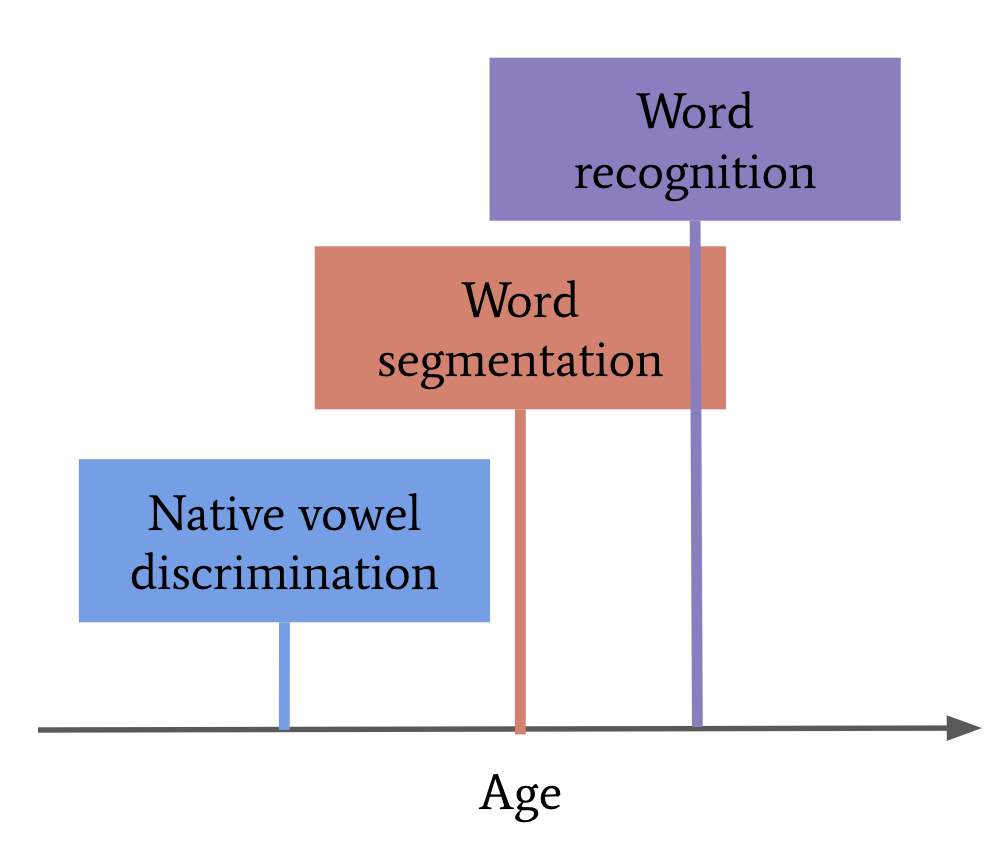
A typical “ages and stages” ordering. Meta-analysis helps us do better.

Developmental psychologists often make statements of the form “babies do X at age Y.” But these “ages and stages” tidbits sometimes misrepresent a complex and messy research literature. In some cases, dozens of studies test children of different ages using different tasks and then declare success or failure based on a binary p < .05 criterion. Often only a handful of these studies – typically those published earliest or in the most prestigious journals – are used in reviews, textbooks, or summaries for the broader public. In medicine and other fields, it’s long been recognized that we can do better.

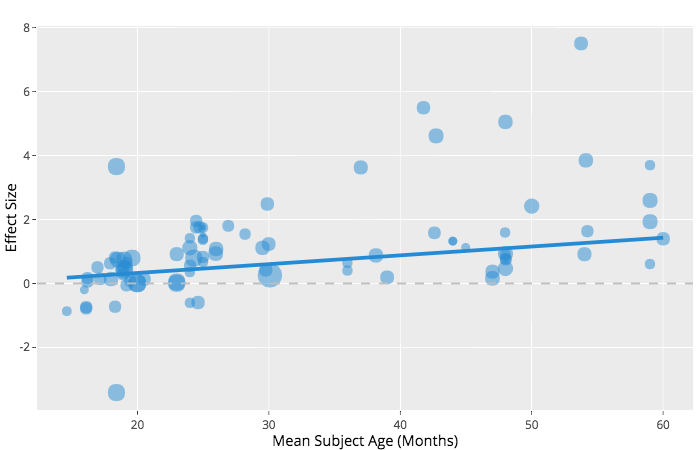
Meta-analysis (MA) is a toolkit of techniques for combining information across disparate studies into a single framework so that evidence can be synthesized objectively. The results of each study are transformed into a standardized effect size (like Cohen’s d) and are treated as a single data point for a meta-analysis. Each data point can be weighted to reflect a given study’s precision (which typically depends on sample size). These weighted data points are then combined into a meta-analytic regression to assess the evidential value of a given literature. Follow-up analyses can also look at moderators – factors influencing the overall effect – as well as issues like publication bias or p-hacking.* Developmentalists will often enter participant age as a moderator, since meta-analysis enables us to statistically assess how much effects for a specific ability increase as infants and children develop. 


An example age-moderation relationship for studies of mutual exclusivity in early word learning.

Meta-analyses can be immensely informative – yet they are rarely used by researchers. One reason may be because it takes a bit of training to carry them out or even understand them. Additionally, MAs go out of date as new studies are published. 

To facilitate developmental researchers’ access to up-to-date meta-analyses, we created MetaLab. MetaLab is a website that compiles MAs of phenomena in developmental psychology. The site has grown over the last two years from just a small handful of MAs to 15 at present, with data from more than 16,000 infants. The data from each MA are stored in a standardized format, allowing them to be downloaded, browsed, and explored using interactive visualizations. Because all analyses are dynamic, curators or interested users can add new data as the literature expands.

Friday, November 10, 2017

Talk on reproducibility and meta-science

I just gave a talk at UCSD on reproducibility and meta-science issues. The slides are posted here.  I focused somewhat on developmental psychology, but a number of the studies and recommendations are more general. It was lots of fun to chat with students and faculty, and many of my conversations focused on practical steps that people can take to move their research practice towards a more open, reproducible, and replicable workflow. Here are a few pointers:

Preregistration. Here's a blogpost from last year on my lab's decision to preregister everything. I also really like Nosek et al's Preregistration Revolution paper. AsPredicted.org is a great gateway to simple preregistration (guide).

Reproducible research. Here's a blogpost on why I advocate for using RMarkdown to write papers. The best package for doing this is papaja (pronounced "papaya"). If you don't use RMarkdown but do know R, here's a tutorial.

Data sharing. Just post it. The Open Science Framework is an obvious choice for file sharing. Some nice video tutorials make an easy way to get started.

Friday, October 6, 2017

Introducing childes-db: a flexible and reproducible interface to CHILDES

Note: childes-db is a project that is a collaboration between Alessandro Sanchez, Stephan Meylan, Mika Braginsky, Kyle MacDonald, Dan Yurovsky, and me; this blogpost was written jointly by the group.

For those of us who study child development – and especially language development – the Child Language Data Exchange System (CHILDES) is probably the single most important resource in the field. CHILDES is a corpus of transcripts of children, often talking with a parent or an experimenter, and it includes data from dozens of languages and hundreds of children. It’s a goldmine. CHILDES has also been around since way before the age of “big data”: it started with Brian MacWhinney and Catherine Snow photocopying transcripts (and then later running OCR to digitize them!). The field of language acquisition has been a leader in open data sharing largely thanks to Brian’s continued work on CHILDES.

Despite these strengths, using CHILDES can sometimes be challenging, especially for the most casual or most in-depth interactions. Simple analyses like estimating word frequencies can be done using CLAN – the major interface to the corpora – but these require more comfort with command-line interfaces and programming than can be expected in many classroom settings. On the other end of the spectrum, many of us who use CHILDES for in-depth computational studies like to read in the entire database, parse out many of the rich annotations, and get a set of flat text files. But doing this parsing correctly is complicated, and often small decisions in the data-processing pipeline can lead to different downstream results. Further, it can be very difficult to reconstruct a particular data prep in order to do a replication study. We've been frustrated several times when trying to reproduce others' modeling results on CHILDES, not knowing whether our implementation of their model was wrong or whether we were simply parsing the data differently.

To address these issues and generally promote the use of CHILDES in a broader set of research and education contexts, we’re introducing a project called childes-db. childes-db aims to provide both a visualization interface for common analyses and an application programming interface (API) for more in-depth investigation. For casual users, you can explore the data with Shiny apps, browser-based interactive graphs that supplement CHILDES’s online transcript browser. For more intensive users, you can get direct access to pre-parsed text data using our API: an R package called childesr, which allows users to subset the corpora and get processed text. The backend of all of this is a MySQL database that’s populated using a publicly-available – and hopefully definitive – CHILDES parser, to avoid some of the issues caused by different processing pipelines.

Tuesday, July 12, 2016

Minimal nativism

(After blogging a little less in the last few months, I'm trying out a new idea: I'm going to write a series of short posts about theoretical ideas I've been thinking about.)

Is human knowledge built using a set of of perceptual primitives combined by the statistical structure of the environment, or does it instead rest on a foundation of pre-existing, universal concepts? The question of innateness is likely the oldest and most controversial in developmental psychology (think Plato vs. Aristotle, Locke vs. Descartes). In modern developmental work, this question so bifurcates the research literature that it can often feel like scientists are playing for different "teams," with incommensurable assumptions, goals, and even methods. But these divisions have a profoundly negative effect on our science. Throughout my research career, I've bounced back and forth between research groups and even institutions that are often seen as playing on different teams from one another (even if the principals involved personally hold much more nuanced positions). Yet it seems obvious that neither has sole claim to the truth. What does a middle position look like?

One possibility is a minimal nativist position. This term is developed in Noah Goodman and Tomer Ullman's work, showing up first in a very nice paper called Learning a Theory of Causality.* In that paper, they write:
... this [work] suggests a novel take on nativism—a minimal nativism—in which strong but domain-general inference and representational resources are aided by weaker, domain-specific perceptual input analyzers.
This statement comes in the context of the authors proposal that infants' theory of causal reasoning – often considered a primary innate building block of cognition – could in principle be constructed by a probabilistic learner. But that learner would still need some starting point; in particular, here the authors' learner had access to 1) a logical language of thought and 2) some basic information about causal interventions, perhaps from the infant's innate knowledge about contact causality or the actions of social agents (these are the "input analyzers" in the quote above).

Thursday, April 14, 2016

Was Piaget a Bayesian?

tl;dr: Analogies between Piaget's theory of development and formal elements in the Bayesian framework.


Intro

I'm co-teaching a course with Alison Gopnik at Berkeley this quarter. It's called "What Changes?" and the goal is to revisit some basic ideas about what drives developmental changes. Here's the syllabus, if you're interested. As part of the course, we read the first couple of chapters of Flavell's brilliant book, "The Developmental Psychology of Jean Piaget." I had come into contact with Piagetian theory before of course, but I've never spent that much time engaging with the core ideas. In fact, I don't actually teach Piaget in my intro to developmental psychology course. Although he's clearly part of the historical foundations of the discipline, to a first approximation, a lot of what he said turned out to be wrong.

In my own training and work, I've been inspired by probabilistic models of cognition and cognitive development. These models use the probability calculus to represent degrees of belief in different hypotheses, and have been influential in a wide range of domains from perception and decision-making to communication and social cognition.1 But as I have gotten more interested in the measurement of developmental change (e.g., in Wordbank or MetaLab, two new projects I've been involved in recently), I've become a bit more frustrated with these probabilistic tools, since there hasn't been as much progress in using them to understand children's developmental change (in contrast to progress characterizing the nature of particular representations). Hence my desire to teach this course and understand what other theoretical frameworks had to contribute.

Despite the seeming distance between the modern Bayesian framework and Piaget, reading Flavell's synthesis I was surprised to see that many of the key Piagetian concepts actually had nice parallels in Bayesian theory. So this blogpost is my attempt to translate some of these key concepts in theory into a Bayesian vocabulary.2 It owes a lot to our class discussion, which was really exciting. For me, the translation highlights significant areas of overlap between Piagetian and Bayesian thinking, as well as some nice places where the Bayesian theory could grow.

Thursday, March 10, 2016

Limited support for an app-based intervention

tl;dr: I reanalyzed a recent field-trial of a math-learning app. The results differ by analytic strategy, suggesting the importance of preregistration.

Last year, Berkowitz et al. published a randomized controlled trial of a learning app. Children were randomly assigned to math and reading app groups; their learning outcomes on standardized math and reading tests were assessed after a period of app usage. A math anxiety measure was also collected for children’s parents. The authors wrote that:

The intervention, short numerical story problems delivered through an iPad app, significantly increased children’s math achievement across the school year compared to a reading (control) group, especially for children whose parents are habitually anxious about math.
I got excited about this finding because I have recently been trying to understand the potential of mobile and tablet apps for intervention at home, but when I dug into the data I found that not all views of the dataset supported the success of the intervention. That's important because this was a well-designed, well-conducted trial. But the basic randomization to condition did not produce differences in outcome, as you can see in the main figure of my reanalysis.


My extensive audit of the dataset is posted here, with code and their data here. (I really appreciate that the authors shared their raw data so that I could do this analysis – this is a huge step forward for the field!). Quoting from my report: 
In my view, the Berkowitz et al. study does not show that the intervention as a whole was successful, because there was no main effect of the intervention on performance. Instead, it shows that – in some analyses – more use of the math app was related to greater growth in math performance, a dose-response relationship that is subject to significant endogeneity issues (because parents who use math apps more are potentially different from those who don’t). In addition, there is very limited evidence for a relationship of this growth to math anxiety. In sum, this is a well-designed study that nevertheless shows only tentative support for an app-based intervention.
Here's a link to my published comment (which came out today), and here's Berkowitz et al.'s very classy response. Their final line is:
We welcome debate about data analysis and hope that this discussion benefits the scientific community.

Monday, December 14, 2015

The ManyBabies Project

tl;dr: Introducing and organizing a ManyLabs study for infancy research. Please comment or email me (mcfrank (at) stanford.edu) if you would like to join the discussion list or contribute to the project. 

Introduction

The last few years have seen increasing acknowledgement that there are flaws in the published scientific literature – in psychology and elsewhere (e.g., Ioannidis, 2005). Even more worrisome is that self-corrective processes are not as fast or as reliable as we might hope. For example, in the reproducibility project, which was published this summer (RPP, project page here), 100 papers were sampled from top journals, and one replication of each was conducted. This project revealed a disturbingly low rate of success for seemingly well-powered replications. And even more disturbing, although many of the target papers had a large impact, most still had not been replicated independently seven years later (outside of RPP). 

I am worried that the same problems affect developmental research. The average infancy study – including many I've worked on myself – has the issues we've identified in the rest of the psychology literature: low power, small samples, and undisclosed analytic flexibility. Add to this the fact that many infancy findings are never replicated, and even those that are replicated may show variable results across labs. All of these factors lead to a situation where many of our empirical findings are too weak to build theories on.

In addition, there is a second, more infancy-specific problem that I am also worried about. Small decisions in infancy research – anything from the lighting in the lab to whether the research assistant has a beard – may potentially affect data quality, because of the sensitivity of infants to minor variations in the environment. In fact, many researchers believe that there is huge intrinsic variability between developmental labs, because of unavoidable differences in methods and populations (hidden moderators). These beliefs lead to the conclusion that replication research is more difficult and less reliable with infants, but we don't have data that bear one way or the other on this question.

Wednesday, October 7, 2015

Language helps you find out just how weird kids are

My daughter M, my wife, and I were visiting family on the east coast about a month ago. One night, M was whining a little bit before bedtime, and after some investigation, my wife figured out that M's pajamas – a new lighter-weight set that we brought because the weather was still hot – were bothering her. The following dialogue ensued:
Mom: "are your pajamas bothering you?"
M: "yah."
Mom: "are they hurting you, sweetie?"
M: "yaaah!"
Mom: "where do they hurt you?"
M: "'jamas hurt mine face!"
Now I don't know where M went wrong in this exchange – does she not understand "pajamas," "hurt," or "face," or does she just think that hurting your face is the ultimate insult? – but there's clearly something different in her understanding of the situation than we expected. One more example, from when I returned from a trip to the mountains last week ("dada go woods!"):
M: "my go woods see dove!"
me: "yeah? you want to see a dove?"
M: "see dove in my ear!"
me: "in your ear?"
M: "dove go in my ear go to sleep."
me: "really?"
M: "dove going to bed."
M is now officially a two-year-old (26 months), and it's been a while since I wrote about her – in part because I am realizing as I teach her the ABCs that it won't be that long before she can read what I write. But these exchanges made me think about two things. First, her understanding of the world, though amazing, is still very different then mine (there are many other examples besides the painful pajamas and the dove in her ear). And second, it's her rapidly-growing ability with language that allows her to reveal these differences.

Children spend a short, fascinating time in what's been called the "two-word stage." There was an interesting discussion of this stage on the CHILDES listserv recently; whatever your theoretical take, it's clear that children's early productions are fragmentary and omit more than they include. Because of these omissions, this kind of language requires the listener to fill in the gaps. If a child says "go store," she could be saying that she wants to go to the store, or commanding you to go to the store. If she says "my spill," you have to figure out what it is she just spilled (or wants permission to spill).

Since the listener plays such a big role in understanding early language productions, they are plausible by definition. There's almost no way for the child to express a truly weird sentiment, because the adult listener will tend to fill in the gaps in the utterance with plausible materials. (This can be quite frustrating for a child who really wants to say something weird.) M's language, in contrast, is now at the stage where she can express much more complex meanings, albeit with significant grammatical errors. So in some sense, this is the first chance I've had to find out just how weird her view of the world really is.

Friday, October 2, 2015

Can we improve math education with a 5000-year-old technology?

(This post is written jointly by my collaborator David Barner and me; we're posting it to both his new blog, MeaningSeeds, and to mine). 

The first calculating machines invented by humans – stone tablets with grooves that contained counting stones or "calculi" – are no match for contemporary computers in terms of computational power. But they and their descendants, in the form of the modern Soroban abacus, may have an edge on modern techniques when it comes to mathematics education. In a study about to appear in Child Development, co-authored with George Alvarez, Jessica Sullivan, and Mahesh Srinivasan, we investigated a recent trend in math education that emanates from these first counting boards: The use of "mental abacus."

The abacus, which originates from Babylonian counting boards dating back to at least 2700 BC, has been used in a dozen different cultures in different forms for tallying, accounting, and basic arithmetic procedures like addition, subtraction, multiplication and division. And recently, it has made a comeback in classrooms in around the world, as a supplement to K-12 elementary mathematics. The most popular form of abacus – the Japanese Soroban (pictured below) – features a collection of beads arranged into vertical columns, each of which represents a place value – ones, tens, hundreds, thousands, etc. At the bottom of each column are four "earthly" beads, each of which represents a multiple of 1. On top is one "heavenly" bead, which represents a multiple of 5. When beads are moved toward the dividing beam, they are "in play", such that each column can represent a value up to 9.

When children learn mental abacus, they first are taught to represent numbers on the physical device, and then to add and subtract quantities by moving beads in and out of play. After some months of practice, they are then asked to do sums by simply imagining an abacus, rather than using the actual physical device. This mental version of the abacus has clear – and sometimes profound – computational benefits for some expert users. Highly trained users – called "masters" by those in the abacus world – can instantly encode and recall long strings of numbers, can add two digit numbers as fast as they can be called out in sequence, and can compute square roots – and even cube roots – almost instantaneously, even for large numbers. Most startling of all, these techniques can be practices while simultaneously talking, and can be mastered by children as young as 10 years of age with record breaking results (see also here, here, and here).  If you haven’t ever seen this phenomenon, take a look at the YouTube video below. It is truly remarkable stuff. 


In our study we asked whether this technique can be mastered to good effect by ordinary school children, in big, busy, modern classrooms. We conducted the research in Vadodara, India, a medium sized industrial town on the west coast of India, where abacus has recently become a popular supplement to standard math training in both after-school and standard K-12 settings. At the charitable school we visited, abacus training was already underway and was being taught to hundreds of children starting in Grade 2, in classrooms of 70 children per group. To see whether it was having a positive effect, we enrolled a new, previously untrained, cohort of roughly 200 Grade 2 kids and randomly assigned them to receive either abacus training from expert teachers or extra hours of standard math training, in addition to their regular math curriculum.

Even in these relatively large classrooms of children from low-income families, mental abacus technique edged out standard math. Though effects were modest in this group, they were reliable across multiple measures of math ability. Also, children attained the best mastery of mental abacus best if they began the study with strong spatial working memory abilities (to get a sense of how we measured spatial working memory take a look at this video).

Why did abacus have this positive effect? One possibility is that learning a different way of representing numbers helped kids make generalizations about how numbers work. For example, the abacus – like other math manipulatives – provides a concrete representation of place value – i.e., the idea that the same digit can represent a different quantity depending on its position (e.g., the first and second 3 in “33” represent 30 and 3 respectively). This better representation might have helped kids understand the conceptual basis of arithmetic. Another possibility is that the edge was chiefly due to the highly procedural nature of mental abacus training. Operations are initially learned as sequences of hand movements, rather than as linguistic rules, and according to users can be performed almost automatically, without reflection. Finally, it's possible that it's this unique mix of conceptual concreteness and procedural efficacy that gives the abacus its edge. Children may not have to learn procedures and then separately learn how these operations relate to objects and sets in the world: Abacus may allow both to be learned at the same time, a welcome tonic to the ongoing math wars.  

Right now it's uncertain why mental abacus helps kids, and whether the effects we've found will last beyond early elementary school. Also, the technique has yet to be rigorously tested on US shores, where it's currently being adopted by public schools in at least two states. This is the focus of a new study, currently underway, which will test whether this ancient calculation technique should be left in museums, or instead be widely adopted to boost math achievement in the 21st century.

Tuesday, July 14, 2015

Engineering the National Children's Study

The National Children's Study was a 100,000-child longitudinal study that would have tracked a cohort of children from birth to age 21, measuring environmental, family, genetic, and cognitive aspects of development at an unprecedented scale. Unfortunately, last year the NIH Director decided to shut the study down, following a highly critical report from the National Academy of Sciences that criticized a number of aspects of the study including its leadership and its sampling plan.

I got involved in the NCS about a year ago, when I was asked to be a part of the Cognitive Health team. Participating in the team has been an extremely positive experience, as I've had a chance to work with a great group of developmental researchers. We've met weekly for the past year, first to create plans for the cognitive portions of NCS, and later – after the study was cancelled – to discuss possible byproducts of the group's work. (Full disclosure: I am still a contractor for NCS and will be until the final windup is completed).

According to recent reports, though, NCS may be restarted by an act of Congress. As originally conceived, the study served a very valuable purpose: creating a sample large enough and diverse enough to allow analyses of rare outcomes, even for parts of the population that are often underrepresented in other cohorts. Other countries clearly think this is a good idea. According to one proposal, though, recruitment in the new study might piggyback on other ongoing studies. I'm not sure how this could work, given that different studies would likely have radically different measures, ages, and recruitment strategies. Even if some of these choices were coordinated, differences in implementation of the studies would make inferences from the data much more problematic.

I would love to see the original NCS vision carried to fruition. But even based on my limited perspective, I also understand why the project was extremely slow to start and ran into substantial cost obstacles. Creating such a massive design inevitably runs into problems of interlocking constraints, where decisions about recruitment depend on decisions about design and vice versa. Converging on the right measures is such a difficult process that by the time decisions are made, they are already out of date (a critique leveled also by the NAS report).

If the NCS is restarted, it will need a faster and cheaper planning process to have a chance of going forward to data collection. Here's my proposal: the NCS needs to work as if it's building a piece of software, not planning a conference. If you're planning a conference, you need to have stakeholders gradually reach consensus on details like the location, the program, and the events, before a single event occurs on a fixed timeline. But if you're building a software application, you need to respond to the constraints of your platform, adapt to your shifting user base, pilot test quickly and iteratively, and make sure that everything works before you release to market. This kind of agile optimization was missing from the previous iteration of the study. Here are three specific suggestions.

1. Iterative piloting. 

Nothing reveals the weaknesses of a study design like putting it into practice.  In a longitudinal study, the adoption of a bad measure, bad data storage platform, or bad sampling decision early on in the study will dramatically reduce the value of the subsequent data. It's a terrible feeling to collect data on a measure, knowing that the earlier baselines were flawed and the longitudinal analysis will be compromised.

The original NCS included a vanguard cohort of about 5,000 participants, mostly to test the recruitment strategy. (In fact, the costs of the vanguard study may have contributed to the cancelation of the main strategy). But one pilot program is not enough. All aspects of the program need to be piloted, so that the design can be adapted to the realities of the situation. From the length of the individual sessions, to the reliability of the measures and the retention rate across different populations, critical parts of the study all need to be tested multiple times before they are adopted.

The revised NCS should create a staged series of pilot samples of gradually increasing size, whose timeline is designed to allow iteration and incorporation of insights from previous samples. For example, if NCS v2 launches in 2022, then create cohorts of 100, 200, 1000, and 2000 to launch in 2018 – 21, respectively. Make the first samples longitudinal to test dropout (so the sampling design can be adjusted in the main study), and make the last sample cross-sectional so as to pilot test the precise measures that are planned for every age visit. Make it a rule: If any measure or decision is adopted in the final sample, there must be data on its reliability in the current study context.

2. Early adoption of precise infrastructure standards.  

Here's a basic example of an interlocking constraint satisfaction problem. You need to present measures to parents and collect and store the data resulting from these measures in a coherent data-management framework. But the way you collect the data and the way you store them interact with what the measures are. You can't know exactly how data from a measure (even one as simple as a survey) will look until you know how it will be collected. But you want to design the infrastructure for data collection around the measures that you need.

One way to solve this kind of problem is to iterate gradually into a solution. One committee discusses measures, a second discusses infrastructure. They discuss their needs, then meet, then discuss their needs again. Finally they converge and adopt a shared standard. This model can work well if the target you are optimizing to is static, e.g. if the answer stays the same during your deliberations. The problem is that technical infrastructure doesn't stay the same while you work – the best infrastructure is constantly changing. Good ideas for data management when the NCS began are no longer relevant. But if the infrastructure group is constantly changing the platform, then the folks creating the measures can't ever rely on particular functionality.

Software engineers solve this problem by creating design specifications that are implementation independent. In other words, everyone knows exactly what they need to deliver and what they can rely on others to deliver (and the under-the-hood details don't matter). Consider an API (application programming interface) for an eye-tracker. The experimenter doesn't know how the eye-tracker measures point of gaze, but she knows that if she calls a particular method, say getPointOfGaze, she will get back X and Y coordinates, accurate to some known tolerance. On the other end of the abstraction, the eye-tracker manufacturers don't need to know the details of the experiment in order to build the eye-tracker. They just need to getPointOfGaze quickly and accurately.

In a revised NCS, study architects should publish a technical design specification for all (behavioral) measures that is independent of method of administration. Such standards obviate hiring many layers of contractors to implement each set of measures separately. Instead, a single format conversion step can be engineered. For example, a standard survey XML format would be translated into the appropriate presentation format (whether the survey is presented on the phone, on the computer, or on a tablet or phone). As in many modern content management systems, the users of a measure could rapidly view and iterate on the precise implementation of the measure, rather than having to work through intermediaries.

A further engineering trick that could be applied to this setup is the use of automated testing and test suites. Given a known survey format and a uniform standard, it would be far easier to create automated tools to estimate completion time, to test data storage and integrity, and to search for bugs. Imagine if the NCS looked like an open-source software project, in which each "build" of the study protocol would be forced to pass a set of automated tests prior to piloting...

3. Independence of measure development and measure adoption.

Other people's children are great, but we all love our own the best. That's why we don't review our own papers or hire our own PhD students to be our colleagues. The adoption of measures into a longitudinal study is no different. If we allow the NCS to engage in measure development – creating new ways of measuring a particular environmental, physiological, or psychological construct – rather than simply adopting pre-existing standards, we need to take care that these measures are only adopted if they are the best option for fulfilling the study's goals.

Fix this problem by barring NCS designers from being involved in the creation of measures that are then used in the NCS. If the design committee wants a new measure, they must solicit competitive outside bids to create it and then adopt the version that has the most data supporting it in a direct evaluation. To do otherwise risks the inclusion of measures with insufficient evidence of reliability and validity.

This recommendation is based directly on my own experiences in the Cognitive Health team. Over the course of the last year, I've been very pleased to be able to help this team in the development of a new set of measures for profiling infant cognition. Based on automated eye-tracking methods, these measures have the potential to be a ground-breaking advance in understanding individual differences in cognition during infancy. I'm now quite invested in their success and I hope to continue working on them regardless of the outcome of the NCS study.

That's precisely the problem. I am no longer an objective observer of these measures! Had NCS gone forward I would have pushed for their adoption into the main study, even if the data on their efficacy were much more limited than should be necessary for adoption at a national scale. I'm not suggesting that NCS would adopt a really terrible measure. But given what we know about motivated cognition and the sunk cost fallacy, it's very likely that the bar would be lower for adopting an internally-developed measure than an external one.

If the NCS acts as a developer of new measures, there is a temptation to continue working to get the perfect suite of measurements, rather than to stop development and run the study. This is the great being the enemy of the good. If the NCS is a consumer of others' measures – on some rare occasions, measures that it has commissioned and evaluated – then it can more dispassionately adopt the best available option that fits the constraints of the study.

Conclusions

My own experiences with the NCS – limited as they are – have been nothing but positive. I've gotten to work with some great people, seen the initial development of an exciting new tool, and glimpsed the workings of a much larger project. But as I read about the fate of the study as a whole, I worry that the independence that's made my little part of the project so fun to work on – developing standards, envisioning new measures – is precisely why the project as a whole did not move forward.

What I've suggested here is that a new version of the NCS could benefit from an engineering mindset. Having internal deadlines for pilot launches would constrain planning with interim goals. Adding precise technical specifications and the abstractions necessary to work with them would add certainty to the planning process and eliminate many redundant contractors; for example, our new measures would probably be off the table simply because they wouldn't fit into the existing infrastructure. And an adversarial review of measures would better allow designers to weigh independent evidence for adoption.

In sum: bring back the NCS! But run it like you're building an app: one that has to fulfill a set of functions, yes, but also one that has to scale quickly and cheaply to unprecedented size.

---
Thanks to Steve Reznick, my colleague on the Cognitive Health team, for valuable comments on a previous draft. Views and errors are my own.  

Sunday, July 5, 2015

Does "time out" hurt your brain?

A recent article in Time Magazine by Daniel Siegel and Tina Payne Bryson argues that "time out" – a disciplinary method that replaces spanking or other physical punishment with enforced social disengagement – is causing harm to children. Siegel and Bryson are authors of The Whole Brain Child, a recent parenting handbook.

Siegel and Bryson make their case using a very weird style of dualistic rhetoric. This is a part and parcel of The Whole Brain Child, whose tagline asks "Do children conspire to make their parents’ lives endlessly challenging? No―it’s just their developing brain calling the shots!" (Personally, I thought it was their spleen.)

Consider this quote from their Time piece:
Studies in neuroplasticity—the brain’s adaptability—have proved that repeated experiences actually change the physical structure of the brain. Since discipline-related interactions between children and caregivers comprise a large amount of childhood experiences, it becomes vital that parents thoughtfully consider how they respond when kids misbehave.
The consequent of this argument – be thoughtful about discipline – seems absolutely true, and practically tautological. It's the first antecedent – the bit about the physical structure of the brain – that worries me. Are we only worried about physical organs? What about the mind, or even the soul? Without some extra premise, for example "...and the physical structure of the brain is more important than what it does," the first part is almost unrelated to the rest of the argument.

Similarly, "In a brain scan, relational pain—that caused by isolation during punishment—can look the same as physical abuse. Is alone in the corner the best place for your child?" The rhetoric is the same: a factual statement about brain science is paired with a statement about parenting, despite their limited relationship to one another. And although relational pain can be incredibly powerful (a couple of years ago, Atul Gawande wrote a wonderful piece on whether solitary confinement should be considered torture), the reason why we believe this has nothing to do with reverse inferences about what the brain shows. It has to do with the behavioral consequences of isolation.

I haven't yet made up my mind about time out. Some parents we know practice it regularly and their children seem fine (though I haven't looked at their brains to make sure they are not physically damaged). And the American Academy of Pediatrics' disciplinary recommendations include a qualified recommendation of time out, with some evidence of efficacy for both older and younger kids. M isn't yet two, and luckily we mostly haven't had too many issues of her acting out – but I can imagine that I wouldn't rule out time out as a punishment.  

More generally, Siegel and Bryson's rhetoric stems from the basic premise that children should be maximally protected from all forms of pain or even discomfort.  Is it better to allow children to have some negative experiences, whether administered by a loving parent or randomly stumbled into? Or should we keep these experiences from them as long as possible, on the thinking that they will have to have them eventually and it is better to establish childhood as a time of greater safety? Though I haven't made up my mind, I think lean towards less protection than Siegel and Bryson do. But it is very frustrating – perhaps even dishonest – to conceal such a critical issue in a fog of brain rhetoric.

Wednesday, February 18, 2015

Stories from the mind of a toddler

Right around the holidays, M started doing something new and charming. Although she had been speaking individual words all throughout the fall, she began to use single word utterances and gestures together to tell stories about events that had happened to her. Even young infants have long-lasting memories that seem tied to individual events, but there's something different about being able to share your memories using language. For us, it meant the first opportunity to have multi-turn conversations with M. She can now share something she's thinking about and we can reminisce about it together.

The first narrative I saw was very simple. Perhaps it was less clearly evocative of a particular event than a class of events, but still different from what came before. M would say "meow" (or her equivalent, which has a lengthened second syllable only, so /aw/) and then make the gesture/sign for come here, palm upright with fingers pulling towards her. This was how she recalled our nightly walks, which tended to go to a street near our house where a friendly cat could occasionally be seen. We'd say "Are you thinking about the kitty cats? ["yah!" replies M] Did you see a kitty last night? [M - /aw/] What did you say to it? [M makes "come here" gesture] That's right - come here, kitty kitty."

So you can see how this little narrative becomes a linguistic routine, something that reinforces the memory it refers to. But this is example is also a little weak; our scaffolding of the memory was probably critical to making it more than just generalized, undirected longing for cats (something that M has quite a bit of).

The second example – the one that really convinced me – came a few weeks later when we took M to a local farm. She had been reading animal books with us for many months, so we thought she'd enjoy the experience. We were right. She was totally transfixed by watching a cow be milked and fed. After we got home, she wanted to talk about the cow a lot. Every fifteen minutes or so, out of nowhere she would moo, but we were confused by what she was trying to express. After mooing, she'd say "uh oh" and point to her tongue.

It took us several repetitions to figure out what M was telling us. Here's the story (in all its toddler glory): when the cow was eating, a lot of its feed fell out of its mouth (hence "uh oh"). But then once we figured out the story, the gesture of food coming out of the mouth got conventionalized into something like the reverse of an "eat, eat" gesture – fingers pressed together, pulling from the mouth. And then we had to do the whole routine over and over again. M: "moo" - parent: "are you thinking about the cow?" M - "uh oh!" and then [falling food gesture]. Ad nauseam. Two months later, she will still tell this story.

When M was very tiny and I had some free nap times, I read a fair amount about baby sign – we never made a decision not to teach signs to M, but life seemed too short. But the most interesting thing I learned was that there was a whole literature on children's spontaneous signs (one paper by the baby sign folks; another by an independent group). The baby sign folks in particular had documented idiosyncratic signs that got built up in structured conversations between parents and kids.

This is exactly the kind of thing M has been doing – she now has a repertoire of such signs that she uses in her narratives, including the "come here," the "falling food" gesture, as well as signs for rain, traffic, and getting splashed in the face by water. Several of them seem quite bound to particular stories, but she has also generalized. For example, her "traffic" sign is pointing and then rapidly swinging her arm back and forth. She spontaneously used this to tell a story about a horse that she had seen, who had both done some messy eating and also run around: "neigh" - [food falling sign] - [running sign]. So these signs do seem at least somewhat flexible and word-like.

Children famously suffer from "childhood amnesia" – the relative inability to recall specific episodic memories from childhood. There are many explanations for this puzzling phenomenon, but one I'm especially fond of (without too much support) is that language plays a role. Episodic memories are not always stored in language, but language provides a medium for encoding and rehearsal. Of course, if language is changing dramatically from the time of encoding to retrieval, that could cause problems for retrieval – hence possible "amnesia."

So I think M's narratives might be a first attempt to express and re-encode episodic memories. The degree to which she retains them will be variable. The relative distinctiveness of the memories will play a role, but the way she encodes them may also matter. The use of signs – which will probably vanish from her vocabulary once she can produce the appropriate words – may help in telling the stories now. But maybe – as the signs fade – she'll also forget the stories more easily?

Tuesday, January 6, 2015

On "training" your children

tl;dr: Analysis of rhetoric from a parenting column. Why, brain, why?

A recent piece in the Washington Post's parenting advice column got me a bit bothered. The question was about how to get a two-year-old to sleep in her own bed if she doesn't want to, and the advice given, essentially, was don't. The columnist, Meghan Leary (a parenting coach) advocates letting the child get in bed with the parents, which is after all what the child wants in the first place.

Although we sleep trained with M, I don't think that the column's advice is necessarily wrong; co-sleeping is a reasonable solution, if it works for the child and the parents. Co-sleeping is the norm in many cultures, and the research suggesting that co-sleeping is hazardous is typically focused on kids who are much younger and at risk for SIDS for other reasons. Of course, probably the reason the parents are asking is because they don't like being elbowed in the face by a toddler. Regardless, what bothered me in the column wasn't the advice, per se.

Instead, it was the rhetorical discussion of why the parents shouldn't sleep train. Here's the argument:
Children are born to attach to a caregiver. They are reliant on that caregiver for years and years — far longer than the young of almost any species on Earth. (Just ask your neighbors about that basement apartment occupied by their 20-somethings.) Without a responsible caregiver, they wouldn’t last a day, let alone a lifetime. Our children need us, and their brains are wired to make sure they stay close to us. 
So, when a 2-year-old has faced separation all day when she goes to day care and then experiences separation again at bedtime, her young brain goes into panic mode. And that young brain is built to take her to the parent, over and over and over.

And so when the parent places a gate at the door, her brain lights up with fear and panic, and it is experienced as a physical problem. Vomiting, breathing problems: This is a systemwide panic meltdown. It is too much for her to process “Why is Mom leaving me?!” and her body starts to compensate for what her brain cannot handle.
Note that this whole passage doesn't have any evidence in it at all, nor any talk about the behavioral history – what the child has experienced prior to the current situation – or even consequences of the child's actions. It also doesn't include any talk about the parents' quality of life. Instead, what replaces these is a set of explanations and expansions of the questioner's original statement that her child cried and threw up when she was left alone in her room at night.

Most of these explanations aren't necessarily wrong – in current form they're really too vague to be judged on the basis of scientific evidence – but they do a lot of negative rhetorical work by invoking -isms that keep people from thinking sensibly about parenting.

Nativism. Nativism in cognitive development is an interesting and important theoretical position, and it has its place. But all of this talk of being "wired" for X or "born to" Y here is just a way of stopping argument about whether a particular behavior is something we want to encourage. Many people would argue that we are born to discriminate against members of other groups, but we should still teach our children values of tolerance and openness. Maybe kids are "born to sleep next to their caregivers" but if that means the caregivers can't get a good night of rest, then perhaps teaching (even "training") can be a reasonable option to consider.

Dualism. When her "body starts to compensate for what her brain cannot handle" this situation sounds pretty dire. But what does that mean? Brain and body (actually, mind and body) are connected. Psychological stress can lead to health problems, etc. etc. So what do we get from separating mind and body here other than an implication that sleep-training related separation anxiety can lead to bad health outcomes, a claim that is not supported by any evidence?

Brain-o-centrism. Why is it the toddler's brain that goes into overload? And why is it her brain lighting up with fear? Again, this seems more like a rhetorical strategy than any kind of evidence. Empty brain statements like these serve as proxies for explanation without any explanatory content.

Anti-daycare-ism. Finally, why does day care have anything to do with this? This little thrown-off clause ("has faced separation all day when she goes to day care and then") really annoyed me – anti-daycare bias is deeply discriminatory against working parents (e.g. like M's mom and me). I know of no evidence that sleep training or sleep problems more generally interact with whether a child is in daycare. There is an interesting and complex body of research on the behavioral consequences of day care, but that's not what is being referenced here. So I find the offhand implication here that day care separation anxiety can cause sleep disturbance to be deeply problematic.

Why am I picking on this one column, whose advice I don't even necessarily dispute? All throughout parenthood I've been confronted with cases where people have very strong opinions about parenting that seem as though they are grounded in the research that I supposedly pursue for a living (trying to understand children's cognitive development). And yet when I look into them more deeply, they make no sense at all. This column, posted on facebook by an acquaintance, was the last straw.

That's it for now. I'm off to pick up M at daycare.

Friday, December 19, 2014

Why can't toddlers play with one another? An alternative account of parallel play

Whenever I go to daycare, or interact with other parents of toddlers,  I hear about how M and other kids her age – 17 months now – are engaged in parallel play. The basic idea is that, even though young toddlers like to be near other kids their age, they don't play together: they engage in the same sorts of activities in close proximity, but without any sort of reciprocal interaction. I'll argue here that this label is at best a descriptive convenience – it doesn't reflect any inability to engage in reciprocal play – and masks an interesting developmental story.

The idea of parallel play idea dates back to Parten (1932), who noted the prevalence of this kind of behavior in young preschoolers. For fun, here's the key figure from her study:
The data are pretty clear – and the graph surprisingly modern! In fact, you can see this sort of thing happening in any daycare classroom, and even more so for 1 - 2 year-olds than the preschoolers in Parten's study. But the question is what to make of this descriptive observation (Parten herself doesn't give much of any interpretation, at least in that paper).

So we turn to the internet. Of course, whattoexpect.com has an interpretation of why parallel play occurs:
[Parallel play is] par for the developmental course for babies and toddlers. Why? Because a child this age is still busy figuring out so much about the world and doesn't yet realize that people his own size are indeed people (who might actually be fun to do stuff with). He's too young to make friends, but companionable side-by-side play is a good start.
You hear this echoed across many other sources of information for parents, including the teachers at M's daycare. These sorts of stage labels are endemic in developmental psych of the popular variety, and they often imply that there is a cognitive change that accompanies the behavioral stage shift. I think this developmental story is deeply wrong.

Over the last 15 - 20 years, a large body of evidence has accumulated that suggests that young children have very robust expectations for the social world by their second year. Babies can build social expectations for almost anything – even for eyeless blobs – so they definitely should have such expectations for other toddlers. Other work suggests that very small cues like reaching, looking, and movement towards a target can effectively cue inferences about an agent's goals and desires. So toddlers almost certainly understand that their peers have goals and desires, perhaps desires that even differ from the toddler's own. In addition, toddlers have no trouble engaging in reciprocal interactions with older children and adults (e.g., giving games, simple games of catch).

In fact, in a recent paper by Cortes and Dweck, having adults engage in parallel play – rather than reciprocal play – with toddlers made them less likely to help that adult achieve a goal later on. So that's a nice piece of evidence for two things. First, parallel play is far from being the only way that toddlers can interact. Second, they actually think it's negative in some way when an adult doesn't play with them reciprocally, so they are forming strong expectations both about and from the type of play they engage in with different partners.

Why do toddlers exhibit so little parallel play, then? I think what's going wrong is that the appropriate social cognitive abilities are very much present in kids of this age, but they are hard to exercise, and critically, social computations are slow. Reciprocal interaction with a peer requires fast online recognition of goals and action planning with respect to those goals. You need to know what your play partner wants you to do, and you need to figure that out before she loses interest and gets distracted. That's pretty easy for adults to do; they create structured play opportunities for toddlers all the time. (For example, last night I set up a tea party for M and helped her serve tea to a wide variety of different stuffed animals).

But when you get two toddlers together, they strike out so often that it might be adaptive to avoid trying to engage! In a recent episode I watched, M saw that another little girl Y wanted a toy car. But by the time she figured out that Y wanted the car, Y had already moved on to other things. The result was that M walked up to Y at a totally inappropriate time and thrust a car in her face for seemingly no reason. Nice idea, but poor execution. Maybe if you are a toddler, you learn not to try out this kind of gambit until you're more confident you will succeed.

This explanation – that parallel play is an adaptive consequence of toddlers' poor speed of processing – is a product of something that I've been exploring a lot on this blog: that babies and toddlers are surprisingly knowledgeable about the world, but their ability to use this knowledge is sharply limited. The limitation here is that social computations are very slow, so that by the time the computations are done, their output is less likely to be relevant. In other words, "parallel play" as a description is correct, but the shift to a more reciprocal style of play may not have anything to do with a cognitive shift. Instead it may emerge from more gradual changes in children's speed of social processing.

ResearchBlogging.org Cortes Barragan R, & Dweck CS (2014). Rethinking natural altruism: Simple reciprocal interactions trigger children's benevolence. Proceedings of the National Academy of Sciences of the United States of America, 111 (48), 17071-4 PMID: 25404334

Monday, November 24, 2014

The piecemeal emergence of language

It's been a while since I last wrote about M. She's now 16 months, and it's remarkable to see the trajectory of her early language. On the one hand, she still produces relatively few distinct words that I can recognize; on the other, her vocabulary in comprehension is quite large and she clearly understands a number of different speech acts (declaratives, imperatives, questions) and their corresponding constructions.

Some observations on production:

  • She still doesn't say "mama." She does say "mamamamamama" to express need, a pattern that Clark 1973 noted is common. She definitely knows what "mama" means, and even does funny things like pointing to me and saying "dada" then pointing to her mother and opening her mouth. 
  • I have nevertheless heard her make un-cued productions of "scissors," "bulldozer," and "motorcycle" (though not with great reliability). Motorcycle translated to something like "dodo SY-ku" – a kind of indistinct prosodic foot and then a second heavily stressed foot. Her production vocabulary is extremely idiosyncratic compared with her comprehension, precisely the pattern identified by Mayor & Plunkett (2014) in a very cool recent paper. 
  • "BA ba" (repeated over and over again) seems to mean "let's sing a song" – or especially, let's watch inane internet children's song videos. We don't do this last all that often, but it has made an outsize impression on her, perhaps because she's seen so little TV in her short life. This is also the first time that she's taken to repeating a single word / label over and over again, so as to emphasize the point. 
And on comprehension:
  • Our life got vastly better when M learned how to say "yes" to yes/no questions. For about a month now, we've been able to say things like "would you like to go outside?" and she will reply "da!" (she is Russian, apparently). "Da" has very recently morphed into "yah" but it's very clearly a strong affirmative. M will occasionally turn her head away and wrinkle her nose if she doesn't like the suggestion. This response feels a lot like a generalization of her I don't want to eat that bite face. 
  • Other types of questions have been slower. Maybe unsurprisingly, "or" is still not a success – she either stays silent or responds to the second option, even if she knows how to produce a word for one or both options. "Where" questions have been emerging in the last week or so. This morning, M was very clear in directing me when I asked her "where should we go?" "What's this" is uneven – occasionally I'll get a "ba" or "da" (ball/dog) type production. And "what do you want" has only gotten a successful production once or twice (bottle, I think). 
  • M understands and responds to simple imperatives just fine: "take the cup to baby" gets a positive response, though her accuracy on less plausible sentences is low.
  • Explanations seem to hold a lot of water with her. I don't think she understands the explanation at all, but if we need to give something to someone, or leave something behind that she's holding, we ask her and then explain. For example, telling her why we can't bring her favorite highlighter pen in the car with us seems to convince her to put it down. What's going through her mind here? Maybe just our seriousness about the idea – something like wow, they used a lot of words, they must really mean it? 
  • She is remarkably good at negation (at least when she wants to be). A few days ago we were headed out the door to the playground, and M tried to drag a big stroller blanket out the door.  I said "We're not going to bring our blanket outside." She headed back over to the stroller, and dropped the blanket. Of course, then she headed back towards the door, turned back, and grabbed a smaller blanket. There was a lot of contextual support to this sequence, but understanding my sentence still took some substantial sophistication. The negation "we're not" is embedded in the sentence, and wasn't supported by too much in the way of prosody. This success was very striking to me, given the failures of much older toddlers to understand more decontextualized negations in some research that Ann Nordmeyer and I have been doing. 
Overall, I am still struck by how hard production is for M, compared with comprehension. A new word, say "playground" might start as something resembling "PAI-go" but merge back into "BA-ba" by the end of a few repetitions. M has never been a big babbler, and so I suspect that she is slow to produce language because the skills of production are simply not as well-practiced. There are some kids who babble up a storm, and I imagine all of the motor routines are much easier for them In contrast, M just doesn't have the sounds of language in her mouth yet.

Friday, October 17, 2014

Semantic bleaching in early language

M is now 15 months, and her receptive vocabulary is quite large. She knows her vehicles, body parts, and a remarkable number of animals (giraffe, hyena, etc.).  Not coincidentally, we spend a large amount of our time together reading books about vehicles, body parts, and animals – at her initiation. Her productive language is also proceeding apace. As one friend astutely observed, she has a dozen words, nearly all of them "ba."*

I've noticed something very interesting over the last three months. Here's one example. When M first discovered the word "da," she used it for several days, with extreme enthusiasm, in a way that seemed like was identical to the word "dog." The form-function mapping was consistent and distinctive: it would be used for dogs and pictures of dogs, but nothing else. But then over the course of subsequent days, it felt like this word got "bleached" of meaning – it went from being "dog" to being "wow, cool!"

The same thing happened with her first extended experience with cats, at a visit to my parents' apartment. She started producing something that sounded like "tih" or "dih" – very clearly in response to the cats. But this vocalization then gradually became a noise of excitement that was seemingly applied to things that were completely different. Perhaps not coincidentally, our visit was over and we didn't have any cat-oriented books with us, so she couldn't use the word referentially. Now that we're back in the land of cat books, the word is back to having a "real" meaning.

This looks to me to be a lot like the phenomenon of "semantic bleaching," where words' meanings get gradually broadened to incorporate other meanings (like the loss of the "annus" – year – part of the meaning of anniversary). This kind of bleaching typically happens over a much longer timescale as part of grammaticalization, the process by which content words can become particles or affixes (e.g. as in the content verb "go" becoming a particle you can use to describe things in the future like "going to X"). But maybe it is happening very quickly due to the intense communicative pressure on M's extremely small lexicon?

The idea here would be that M only has a very small handful of words. If they don't fit the current situation, she adapts them. But mostly the communicative context she's adapting to is, "hey, look at that!" or "let me grab that!" So the process of bleaching words out from "dog" to something more like "cool!" could actually be a very adaptive strategy.

I've checked the research literature and haven't found anything like this described. Any readers know more?

---
* It's really more like ball ("ba"), balloon ("ba", but possibly just a ball), bus ("ba"), perhaps baby ("ba") and bottle ("ba") as well, dog ("da"),  yes ("dah"), cat/kittie ("dih"), truck ("duh"), daddy ("dada"), yum ("mum-mum"), more ("muh"), hi ("ha-e"), and bye ("ba-e"). Some of these are speculative, but I think this is a pretty good estimate.

Thursday, August 28, 2014

More on the nature of first words

About two weeks ago, M – now 13 months old – started using "dada" to refer to me. She has been producing "da" and "dada" as part of her babble for quite a while, but this was touching and new. It's a wonderful moment when your daughter first calls to you using language, not just a wordless cry.

Of course, congruent with what happened with "brown bear," I haven't heard much "dada" in about a week. She still seems to understand it (and likely did before producing it), but the production really seems to come and go with these first words. Now she's big into balls and appears to produce the sequence "BA(l)" pretty consistently while pointing to them. (I'm writing "BA(l)" because there's a hint of a liquid at the end, in contrast to the punctate "ba" that she uses for dogs and birds that we see at the park).

I want to comment on something neat that happened, though. In the very first day of M's "dada" production, we saw two really interesting novel uses of the word, both supporting my previous discussion about the flexibility of early language.

The first use was during a game we often play with M where she unpacks and repacks all the cards in my wallet. A couple of years ago, I lost my credit cards several times, and the bank started putting my photo on my card. (I think they do this for folks who are at high risk for identity theft). During the wallet-unpacking game, M took one of the cards, pointed to the photo of me (a small, blurry, old photo at that), and said "dada."

Kids do understand and recognize photos and other depictions early in life. My favorite piece of evidence for children's picture understanding is a beautiful old study by Hochbert & Brooks (1962). They found that their own child, after being deprived of access to drawings and photos until the age of 19 months, nevertheless had very good recognition objects he knew from both kinds of images, the very first time he saw them.* M's generalization of "dada" to my photo thus might not be completely surprising, but it certainly supports the idea that the word was never dependent on me actually being there.

The second example, reported by my wife, is even more striking.  When I had stepped out of the house for a moment, M pointed to the bedroom door where I had been and said "dada" – as though she was searching for me. This kind of displacement – use of language to describe something that is absent  – is argued to be a critical design feature of language in a really nice, under-appreciated article by Hockett (1960). Some interesting experiments suggest that even toddlers can use language to learn about unseen events, but I don't know about systematic studies of the use of early words to express displaced meanings. M's use of "dada" to refer to my absence (or perhaps to question whether I was present but unseen) suggests that she already is able – in principle – to use language in this way.

More broadly, in watching these first steps into language I am stunned by the disconnect between comprehension and production. Production is difficult and laborious: M accomplishes something like "brown bear" or "dada" but then quickly forgets or loses interest in what she has learned.** But the core understanding of how language works seems much more mature than I ever would have imagined. For M, the places where she shows the most ability is in understanding language a signal of future action. When we say "diaper time" or "would you like something to eat?" she apparently takes these as signals to initiate the routine, and toddles over to the changing pad or dinner table. But when we're in the middle of the routine, saying "diaper" doesn't inspire her to point to her diaper.

Again and again I am left with the impression of a mind that quickly apprehends the basic framework assumptions of the physical and social world, even as carrying out the simplest actions using that knowledge remains extraordinarily difficult.

----

* Needless to say, this was an epic study to conduct. Drily, H&B write in their paper that “the constant vigilance and improvisation required of the parents proved to be a considerable chore from the start—further research of this kind should not be undertaken lightly.”

** On a behaviorist account of early language, M would never forget "dada" – I was so overjoyed that I probably offered more positive reinforcement than she could even appreciate.

(minor updates and typo fixes 7/29)